the Festival Choir on the road

Most of the Three Choirs Festival rehearsals are on home territory in Gloucester, but there are a couple of away fixtures at the other two cities.  First up was Worcester, which I had to drive all the way to as I missed the coach (and failed to head it off at Tewkesbury).  The rehearsal was in the ‘big room’, and I couldn’t help noticing how comfortable and solid the staging was.  In my time I’ve sat on some rather rickety temporary staging; I recall being on the extreme top corner of a fragile setup singing Gerontius in Ely, and Bristol Cathedral’s is rather gappy in places.  Memo to Cathedrals: get your staging from whoever supplies Worcester’s.

I did make the coach to Hereford, and enjoyed the ride through rolling countryside.  We rehearsed at the Cathedral School, in a building which was once a telephone exchange.  I imagined the room as it might have been once, full of machinery and cables.  There must be lots of former telephone exchanges around as they take up much less space than they used to.

Posted in festivals | Tagged , , | Leave a comment

the themes of the Festival

I’ve been a bit quiet recently. Most of my singing activity has been rehearsing for the 3 Choirs Festival, and what goes on in the rehearsal room stays in the rehearsal room, or at any rate doesn’t appear here. I’ve also been doing some negotiating in connexion with another choir I have sung in, which I’m not going to discuss online.

One side-effect of performing six major works (plus some bits and pieces in the opening service) all in one go is thinking about how they play off against one another and what they have in common. Berlioz and Mahler, for example, as well as sharing a taste for the gargantuan, have a way of doing really profound things with apparently trite melodies (no shortage of those in Carmina Burana either). How do Elgar and Mahler tackle the theme of the Holy Spirit? What about the way Elgar and Mendelssohn deal with setting Biblical stories? How do Vaughan Williams and Berlioz depict lamentation? Where can you trace the influence of plainsong in Elgar and Berlioz? Any significance in the fact that three of our composers are of Jewish descent? It will be interesting to ponder these sorts of questions with all the pieces in close juxtaposition.

Posted in repertoire | Tagged , , , , , , , | Leave a comment

Gloucester’s best kept secret

Junction 11a of the M5 is one of the more mysterious bits of the British motorway network. Leaving the motorway there to drive into Gloucester is straightforward enough but try finding the junction starting from Gloucester and it is a different matter. Road signs are coy about admitting that it exists, and, should you succeed in finding the way there, instead of the usual roundabout and gentle slip road you are spun in a tight counter-clockwise three-quarter turn in order to continue your journey south.

It has a certain similarity to the Kalmus scores of Mahler 8 that we are using. You might have thought that following the soprano line in choir 1 might be straightforward, but that is far from being the case. One moment you are sailing along at the top of the system, but move on a page and your line is buried under a pile of assorted soloists and kiddies, or gone altogether, only to reappear in the middle system a few pages later. To add to the gaiety of nations we 2nd sopranos have had a few alto titbits tossed in our direction for balance reasons. Usually I don’t mark up a score with anything heavier than pencil, but this is an extreme case, and I’ve bought some translucent adhesive strips in assorted colours to pick out my line. I haven’t done it for every single line – if I can’t locate the start of the Chorus Mysticus I don’t deserve to be called a singer of Mahler – but I’ve marked most of them, colour-coding a warm orange for the alto bits. I’ve also written ‘tacet’ in pencil at the top of all the pages where I don’t sing anything.

image
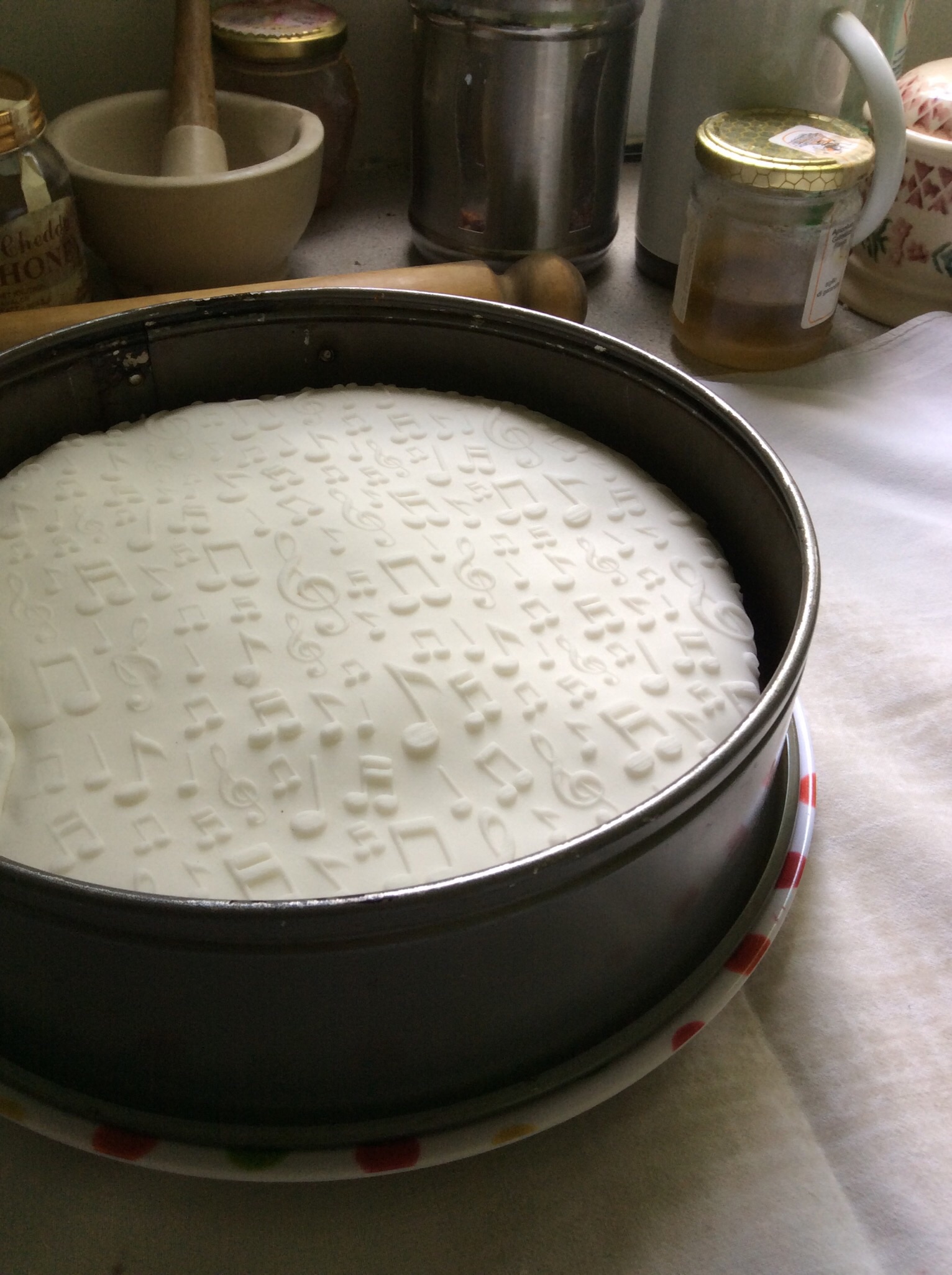
As this is the Internet, here’s a picture of some cake, made by me for yesterday’s all-day rehearsal when my newly highlighted score got its first outing:

This is the second time in as many years that I’m singing in a performance of Mahler’s Eighth Symphony. Last year was good preparation – not least because I’m no longer frightened of fast tempi in this piece – but I’m now singing second soprano in the first choir rather than first soprano in the second choir. There are a few things about the rehearsals last year that I rather fondly miss: Gavin’s way of giving upper-voice cues in falsetto for example. But one thing they have in common: both sets of rehearsals have been blessed with a superb standard of accompaniment. The Gloucester contingent is Choir 1, while our Hereford and Worcester counterparts make up Choir 2, so when we rehearse separately there’s a Choir 2-shaped hole. Saturday was the first time we had Choir 2 with us and I could look back on all the bits I sang last year with a certain amount of nostalgia.

Posted in repertoire | Tagged , , | Leave a comment

the Chantry Singers reunion

The Chantry Singers disbanded in autumn 2010. A couple of years ago there was a reunion, and as it was a success they had another one – in the meantime I’d got myself added to the invitation list as a former member of the choir. I wasn’t in fact in the Chantry Singers all that long – two separate periods of time adding up to about four years, most recently in 2004 – and you will look for me in vain on any choir photos. But the choir had quite a slow turnover (much less, for example, than non-founder members of the Exultate Singers), and a reunion is more likely to attract those who were part of the choir for a long time, so I recognised almost all of the people present. Talking to a former committee member, I realised that I probably left at the wrong time, as soon afterwards its organisation was reformed so that the choir was no longer slightly expanded or slightly reduced for some concerts (it did continue to include the occasional ‘bumper’ though).

We rehearsed assorted mostly sacred pieces and performed most of them at the end. This provided (like the recent rehearsal of Elijah) further evidence that once I’ve sung a piece I never totally forget it. Among the pieces were Lennox Berkeley’s Missa Brevis and Haec dies by Donati. I did the Berkeley a couple of times as a student and the Donati just once, even earlier, and yet once I started singing them I recognised both. Unfortunately while I don’t totally forget pieces (with the possible exception of some totally unmemorable ones) I don’t remember them perfectly either. There were some other pieces that were new to me: part of Josquin’s Missa de Beata Virgine, Victoria’s Dum complerentur, Peter Philips’ Gaudent in caelis, (surprisingly) Byrd’s O Lord make thy servant Elizabeth, Les fleurs et les arbres by Saint-Saëns, and more recently Ave Verums by Paul Mealor and Philip Stopford.

Posted in choirs, singing - other | Tagged , , , , , , , , , , | Leave a comment

Bach cello suites at the Festival

Philip Higham played all six Bach cello suites in three lunchtime concerts and between us we got to all of them. The venues were scattered around the city centre: Argyle St URC church, St Swithin’s and the Masonic Hall.

This was an impressive achievement as all three recitals were given from memory and the suites were fluently and expressively played. But comparing notes we both found that the performances were a little too soothing and lacking in drama. It was also rather disappointing that there weren’t more people there – I noticed some notable local Bach enthusiasts were absent. The Festival has some way to go to regain the popularity it once had.

Posted in going to concerts | Tagged , , , , , | Leave a comment

an organist’s wedding and two Festival concerts

There was just too much going on on May 21st. I had been due to sing a concert in Reading but asked to be released from it when I realised there were enough sopranos and some unrepeatable events going on in Bath. Among these was the wedding of a former organist to a current choir member at my church. Surprisingly, I’ve only once before sung at the wedding of an organist (I have attended three such events, but a professional singer was hired at one). It has the advantage that you are guaranteed quality music, at a time when I am now selective about which weddings I sing at. Though I don’t expect many grooms sit down at the console shortly before the entry of the bride and play the Radetsky March, as happened here.

In the meantime my husband went to hear the Navarra Quartet at the Guildhall in the International Music Festival. They played Haydn’s Op. 76 no. 1, followed by the third quartet of Peteris Vasks. This latter was enjoyable though not particularly groundbreaking. Then they moved on to Beethoven’s Op. 131. This they did justice to without being outstanding, with distinctive but blended tone. One visual trick was missed: because the viola player sat between the violinists, a phrase that was surely intended to move from one player to their neighbour instead jumped around.

Later in the afternoon he went to hear Nicholas Mulroy sing Die Schöne Müllerin accompanied by Alisdair Hogarth. To begin with the piano was too loud, and then slightly over-corrected and became unobtrusive. The performance was acted as well as sung, coming over well, although at one point a mispronunciation destroyed a rhyme in the lyrics (at which point the singer noticed what he’d done).

Both concerts were rather thinly attended and the Festival is presumably trying to attract back the audiences that it has lost in recent years. Certainly the programme this year featured plenty of classical concerts.

Other events on this busy day included a school fair (which I went to) and a pamper evening (which I had to miss), and I’m sure there were other things too.

Posted in festivals, going to concerts, singing at services | Tagged , , , , , , , , , , , | Leave a comment

20th anniversary

It’s our 20th wedding anniversary this month – so who from 1996 remains on the local musical scene? (Strictly speaking, I didn’t arrive in Bath till late August, but I started investigating choirs before I moved here.)

In Bath, we have Peter King as organist of the Abbey (but he’s about to retire), Keith Bennett still conducts the Paragon Singers (but hands them over at the end of the year), and Nigel Perrin is in charge of the City of Bath Bach Choir. On the orchestral front, Jason Thornton conducts the Bath Philharmonia, though they are now a professional group. I’d be interested to hear of anyone else still waving their arms in front of the same group of people. [The DoM at my church points out that he will have been in post 20 years, at the end of this year.]

I’m less sure about Bristol, as I didn’t really have contact with its musical scene for the first few years I was in the area. But one piece of continuity is that John Marsh still directs the Lord Mayor’s Chapel choir, having taken over 20 years ago, as a retirement post! (Sadly his predecessor died just as he was giving up the job.)

In that time some choirs have disbanded: the Chantry Singers, the Bath Festival Chorus and the Brandon Hill Singers for example. I also note that I’ve been waiting to sing with some local groups for almost as long as I’ve lived in Bath. I went on a waiting list for auditions with the Paragon Singers in 1998 and although I’ve been on the dep list for the Lord Mayor’s Chapel for 20 years I’ve never been asked to sing with them or with the Lord Mayor’s Chapel Singers. When 3 Choirs folk ask me ‘why are you singing with a choir so far from where you live?’ I sometimes point out that this is what happened when I tried locally.

Posted in choirs | Tagged , , , , , , , , , , , , | Leave a comment

owning the notes

I am now finding out just how well I know (or don’t) the Three Choirs pieces, and so how much work I need to do on them. The pieces for the six main concerts divide neatly into three pairs in this respect. Firstly the Berlioz and Mahler, both of which I’ve performed within the last two years. (Not that this means they don’t need looking at too, especially as I’m performing both from editions I haven’t used before).

Then there are two pieces that are better known to those around me than they are to me. Carmina Burana seems to be falling into place, especially as most of the other singers have performed it very recently. Lots of repetition and unlike Vaughan Williams no sudden startling changes of key, in fact few changes of key of any kind. My fellow singers are also collectively familiar with Elijah. I have performed this once before, when I was a student (and so probably with little rehearsal) and I was quite unsure how much I’d remember. I had dim blurry memories of the piece, as if I were looking up at it from the bottom of a swimming pool; but when we sing it I am more confident than I expect, so it must have lodged in the memory to some extent.

Finally, two pieces that are new to most of the choir, including me. I obtained a copy of Dona Nobis Pacem earlier this year and started to learn it soon after performing the Sea Symphony, while Vaughan Williams was still in my system. I find it rather easier to learn than the symphony, perhaps because VW’s style had evolved in the meantime into one I was more familiar with from other pieces.

Where I come adrift though is The Kingdom. I tried to take part in a performance that never happened a few years ago, but it never got even to the rehearsal stage. I’ve been through the score, and it seemed straightforward and even a bit on the dull side, but I realise I’ve underestimated the piece. The tempo is very fluid and along with the notes you have to be prepared for frequent changes of speed. Clearly, as with the Vaughan Williams, Elgar’s style had moved on significantly since Gerontius.

Posted in repertoire | Tagged , , , , | Leave a comment

the work I’ve avoided to date

All my life I’ve managed to avoid singing Carmina Burana, but it was bound to catch up with me sooner or later, and that moment has now arrived. This is one of those pieces that polarises singers and audiences. What exactly is my problem with it?

Orff’s role in the Third Reich is never going to be easy to gloss over. If I read the accounts of his life correctly, he was unprincipled, selfish and dishonest. But if we only performed music by the morally noble, the repertoire would be a lot smaller. And while I’d like to think that if history repeated itself, and ‘degenerate’ scores were destroyed, they would have to come and tear the last copy of the Altenberglieder or Lyric Suite out of my hands, I don’t know that I wouldn’t have behaved the same way as Orff in his situation.

My real problem is more with the percussive and apparently unmelodic vocal lines and lack of thematic development. However, I am willing just this once to be open to persuasion that there are subtleties in the piece that I’ve missed. I’m not, after all, rehearsing just this piece for weeks on end; it comes as part of a package. And the ticket sales show that there are plenty of people out there who want to hear it. There’s something to be learned from actors, who are always enthusing about their latest project no matter whether it happens to be to their taste or not.

And there are some things to be said for Carmina Burana:

  • The rigid rhythms are an antidote to the very flexible tempi in The Kingdom
  • It’s one of the rare works with a choral top C for the sopranos – and one of the rarer ones that gives it to the whole section, not just the 1sts
  • The lyrics make it clear (as I suppose does the continued existence of the human race) that sex did not disappear after ancient times, only to re-emerge in 1963
  • It is apparently good background music for wine tastings
Posted in repertoire | Tagged , | Leave a comment

The adventure begins

At last – some eight months after I auditioned – the rehearsals for the Three Choirs Festival Chorus are starting. Easily the biggest single choral undertaking I’ve ever been involved in. I have cleared my diary, bashed as many notes as I can (and I have to learn an awful lot of them for the first time), pencilled in all the markings and am ready to go.

I’ll be reporting from time to time, but because I don’t report on how things are going overall, it will mostly start off by being about my experience of learning Dona Nobis Pacem, Carmina Burana, The Kingdom and Walton’s Festival Te Deum – and that of re-encountering Elijah after many years. Perhaps contrary to the experience of others in the choir, Mahler 8 and the Grande Messe des Morts will be light relief to me, as those are the pieces I already know.

Posted in choirs, festivals | Tagged | Leave a comment

Two funerals

I’ve recently been to a couple of funerals – one as an invited singer, one as a family friend.

The former was my first visit to Bath crematorium and its chapel overlooking farmland south of the city. The family wanted the mourners to be given a lead in Crimond (a hymn that is only ever sung at weddings and funerals in my experience). The other was a Roman Catholic Requiem Mass in a small and full church. The music was a mixture of plainchant Ordinary and Propers and the sort of hymns popular in evangelical churches in the 1980s or so – rather surprisingly, given the advanced age of the lady whose Requiem it was.

The Requiem Mass had a singer from the church to lead the congregation (and teach them plainchant by moving her hand up and down). In both cases I had to set my dynamic level correctly – loud enough so that those nearby who were less confident could latch on to it, but not so loud as to predominate.

Posted in funeral, singing at services | Tagged , | 2 Comments

Gibbons for the Gaudy

I went back for a Gaudy at my old Oxford College, Merton. It was the first Gaudy I’d been invited to for 9 years, and the first since the choral foundation was set up. A selection of choir members sang at a very well attended Evensong in Chapel, the music including Gibbons’ Short Service and his If ye be risen with Christ, the latter sung at the East end by the chamber organ.

I get some information about the choir via the Friends scheme, though communications (especially by email) have broken down a little recently. I was officially told about a broadcast by the choir only on the day it happened, and received an invitation to a recital four days after it had taken place! These were last October, and probably fell through the net because the post of verger was unoccupied during the Long Vacation so there was no one to send the message out.

I gather the new organ is proving popular for recordings, and indeed has just been used on one made by one of the other major Oxford choral foundations. Looking at the music lists, I notice also that the repertoire includes fewer 21st century pieces than it did a few years ago. I got a chance to congratulate the choir as I came across them eating their dinner in the Savile Room afterwards.

Posted in going to services | Tagged , | Leave a comment