my Clifton Cathedral début

I could have performed in Clifton Cathedral on a number of occasions – for example, if I’d joined the Bath Festival Chorus – but have never actually done so. The Cathedral doesn’t host many concerts, and I believe that Bristol Choral Society’s Messiah was the first performance of the piece there this millennium. (I am, as always, happy to be corrected if I get my facts wrong.)

It is a building uncompromisingly of its time – not for nothing did it win a Concrete Society Award in 1974 – and a large choir has to make room for the altar, so there is a very large distance between the front and the back. Also a ‘naughty step’ for the second row to sit on, rather than chairs. I did not find the resonant acoustic misleading, but it probably helped that I was in the front row.

We had a gratifyingly capacity audience on what was a very busy night for choral concerts in Bristol, and after another performance of Messiah nearby three days earlier. I enjoyed returning to the work after two years, but don’t regret not having sung it last year (about every three years is right for me, I think). Our performance got a five-star review in the Bristol Post.

Posted in singing in concerts | Tagged , , , , | Leave a comment

Organathon!

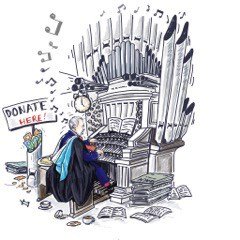
Today my church is running an ambitious sponsored event: our organist Keith Pigot has come up with 12 hours of repertoire and is playing from 7am-7pm in aid of the repair and restoration of our organ. I went over to hear him fairly soon after the start and he was going strong; I’ll return at lunchtime to check on him and give out mulled wine and mince pies to those who’ve come to hear him.

I’m happy to report he reached the £2000 target at about 10 this morning but all further support is welcome: donate at Organathon. Or of course come along to the church in person today and hear the performance! organathon

We would really like to make our organ into a proper recital instrument and not just repair recent damage from falling plaster.

I once organised a similar event in aid of RAG at university: 12 hours of hymn singing. But it wasn’t all done by just one person!

Posted in category-defying | Tagged , | Leave a comment

a memorial and a Requiem

17th November turned out to be a busy day musically. In the morning I was in the choir for a memorial service for the parents(-in-law) of two members of my church choir, in the small parish church in Winsley. I appreciated the generous catering at the lunch afterwards, as I then had to hot-wheel it over for the Keynsham Orchestra and Chew Valley Choral Society’s performance of Duruflé’s Requiem in the parish church there.

I had two reasons for jumping at the chance to sing in this concert (which came via Bristol Choral Society). Firstly, these concerts have the enjoyable feel of a community event, which you don’t get even in Bath and certainly not in Bristol. I know one or two in the orchestra and you can purchase more generous catering in the shape of home-made cake in the interval. Secondly, although I have sung Duruflé’s Requiem countless times, I have only once before done it with full orchestra, in an All Souls’ Day Mass at St Mary Magdalene, Paddington. It is a very different animal from the more austere organ accompaniment one usually gets, with much extra colour and counter-melodies which are not to be found in the other version.

I was in the audience for the first part of the concert, Ravel’s Pavane pour une infante défunte, which I was hearing for the second time that week, and the suite from the ‘Firebird’. Our soloists in the Requiem were Angharad Watkeys and Niall Hoskin and the conductor was Mark Gateshill. I was behind the horns which was not as deafening as you might think and gave me a chance to appreciate some of the counter-melodies mentioned above, for example near the beginning of the Libera me. Our performance was warmly received by a good-sized audience.

Posted in Uncategorized | Tagged , , , , , , , , , , , , | Leave a comment

Bath Mozartfest (3) – Sitkovetskys and Tallis Scholars

My husband went to hear the regular Festival visitors, the Sitkovetsky Trio, give a lunchtime recital at the Guildhall. They were not quite on their best form. Haydn’s ‘Gypsy Rondo’ trio worked well but Schubert’s D929 trio is rambling and they didn’t really find an inventive solution to this.

I was lucky to get a ticket to the Tallis Scholars’ concert in St Mary’s Bathwick as there was just one left in the =main aisle. I last heard them in Merton College Chapel in a fundraising concert. The programme ‘The Path to Purcell’ didn’t pretend to connect to Mozart and I wondered whether it might be linked to a forthcoming recording? I’m not complaining as it’s one of my favourite areas of repertoire.

Most of the music was pieces I’ve sung and in a number of cases am very familiar with. We got both Tomkins’ and Purcell’s settings of My Beloved Spake and O Sing unto the Lord. I have sung many performances of Tomkins’ canticles and of course the Responses, but only isolated ones of his anthems, which don’t seem to have found a very firm niche in the repertoire. Other composers represented were Gibbons and Pelham Humfrey.

The Purcell component was very much a selection of the ‘greatest hits’ among his anthems. I noticed that they went for the unusual variant of Eb and Db at the end of bar 63 in the alto part of Jehovah, quam multi sunt hostes mei. This imprinted on me because I discovered the anthem via a broadcast from Salisbury Cathedral which used it, but I’d never heard it since then until now! Now when am I ever going to sing My beloved spake?

Different singers were used in the different pieces, moving so nimbly around between them (they must be very practised at this) that one barely noticed. The performances were as polished as you’d expect from this group, with timbres of the individual voices distinguishable, yet blending with one another. Accompaniment was provided where necessary by James McVinnie on an imported chamber organ (not the Willis on Old Philharmonic pitch which lives in the church!) There were many I knew in the audience and the mood was set by lighting our seating with candles.

Posted in going to concerts | Tagged , , , , , , , , , , , | Leave a comment

Bath Mozartfest 2018 (2) – Angela Hewitt

We went to the Assembly Rooms on the Sunday night to hear Angela Hewitt, a regular visitor. She began with Mozart’s C minor sonata, which didn’t always seem totally secure. Beethoven’s Waldstein Sonata was more settled and played with complete assurance. During this piece I felt the tuning of the Fazioli piano was coming slightly adrift, and sure enough the tuner appeared in the interval and was at work for some time.

The second half began with another Mozart sonata, K576 in D major, again one that was’t written primary as an exercise for his pupils. The final piece was a performance of Ravel’s Le Tombeau de Couperin that alternated between the virtuosic and the reflective. I used to play some of this (not the final movement!) and still have a score. I’d heard the orchestral version on Radio 3 a few days previously which was a useful comparison, although there are two extra movements in the piano original. As with Hewitt’s interpretation of Liszt’s Sonata a few years ago, it was clear that she enjoys more recent pieces that reference the baroque. We were told this had not been programmed with the Armistice anniversary in mind, but it was obviously appropriate to it. The encore was the same composer’s Pavane pour une infante défunte.

We’d observed the centenary of the Armistice earlier at church, appending half an hour of readings and music to our usual service. So it was a six-anthem morning, perhaps the most notable inclusion being the addition of the Russian Kontakion to our current repertoire.

Posted in going to concerts | Tagged , , , , , , | Leave a comment

Bath Mozartfest 2018 (1) – the Nash Ensemble

This year’s Mozartfest boasted a particularly appealing programme with stellar performers, and it was possible to come by tickets for all the concerts we wanted to go to – maybe a consequence of austerity? I made a point of going to the first Saturday morning concert in the Assembly Rooms, with the festival regulars, the Nash Ensemble, who brought along with them the likes of Michael Collins and Adrian Brendel.

Mozart’s string quintet K593 had a formal sophistication which marked it out as a late work and in some sense the most mature work on the programme. Weber’s Clarinet Quintet in B flat was essentially a showcase for the clarinettist (Michael Collins) – a concerto with the orchestra replaced by a string quartet. They had an accompanying role and you never really got to hear them pass material around themselves or have a solo line as individuals. Once you accepted that, it was an enjoyable piece with a virtuoso clarinet line played with ease.

Beethoven made various youthful excursions into multi-instrument chamber music, and in the early days of this blog I wrote about the Nash Ensemble playing one of the less successful ones. By the time he wrote the Septet he’d solved the problems of balancing the instruments, and after the Weber I was carefully checking that everyone had their moment of glory. They did – a set of variations gave good opportunities for this – and even the double-bass player came through in some of the lighter scored passages. The work has the multi-movement form of a serenade, and as far as I can tell is the earliest septet to have made a mark on musical history, with quite a few later composers taking up the challenge.

The concert was well attended, but I saw very few of school age, which is a shame when the timing was friendly to young people. I still think about the chandeliers in the Assembly Rooms, but having watched some of the world gymnastics championships recently, I now imagine the sort of routine a top gymnast might construct around them.

Posted in going to concerts | Tagged , , , , , , , | Leave a comment

rejoining a couple of former choirs

I did a bit of moonlighting at a couple of churches I used to sing in. First came a service for All Souls’ Day in Bathwick. We were in the side aisle, but this time for the good reason that new underfloor heating is going in the nave. The choir contained some of those who used to sing at the church with others from the other church in the benefice. Our conductor had an admirably gung-ho attitude when people appeared not to be watching during the rehearsal – pulling around the tempo to see who followed him and who didn’t!

At the weekend I was over in Cambridge and sang for the first time in a few years for an ordinary Mass (i.e. not a Requiem) at Little St Mary’s. In fact it was the Feast of Dedication, which meant an overlap with one of the hymns we had at our wedding in this church. The choir is quite a lot larger than it used to be (it helps that there is no longer an annual turnover of choirmasters, as there was when I lived in Cambridge) and has junior choristers in alternate weeks. Another difference is that the singing of plainchant is more nuanced; rather than singing the same psalm tones in the same way to the proper texts each week, there is some of the plainchant appropriate to that day in the liturgy, with expression marks of various kinds. As I’m not a plainchant expert, I let others take the lead in this.

I finished my weekend in Cambridge by going to King’s College Chapel for Sunday evensong, where I heard the eponymous canticles by Howells and Let all the world by Vaughan Williams.

Posted in going to services, singing at services | Tagged , , , , | 2 Comments

The Serenade to Music

Vaughan Williams’ Serenade to Music has been another piece on my wishlist. A while back there was a proposal to perform it in Bath with me and 15 other singers, but it didn’t happen. It can be done also with a choir and four soloists, but Bristol Choral Society did it in Bristol Cathedral in the fully choral version; there’s no change in the score, so one minute you are doing a rather undemanding part for massed voices and the next you are pretending to be Eva Turner or Isobel Baillie. We used a reduced orchestration for strings and piano. I shall understand this piece better next time I hear it in a concert.

The other Vaughan Williams in the concert was Dona Nobis Pacem, written slightly earlier, which is getting a lot of performances in the WWI centenary period, including the one I sang at 3 Choirs a couple of years ago. This too was given in an arrangement for strings and piano, so you had to imagine the brass in the second movement. On the other hand this performance had more expressive flexibility with regard to tempo. I suspect this piece will withdraw from concert programmes again once the centenary is past, but perhaps it might be time to look at RVW’s other cantatas, Sancta Civitas and Hodie – both are just names to me. [I’ve since done Sancta Civitas and found out why it is rarely performed – not want of musical quality.]

Our programme was completed with Howells’ Elegy and Farewell to Arms by Finzi. This last is not exactly a song cycle, just two thematically related poems set for tenor and strings. I thought I knew Finzi’s music quite well, but I was unaware of it. It was an inspired complement to the other pieces.

Posted in singing in concerts | Tagged , , , , , , | Leave a comment

Weelkes in Winchester

It was a quick return to Winchester, this time with the Erleigh Cantors. Slightly worryingly, the place where we rehearsed in the summer was off-limits because of dodgy electrics, so we were displaced to Pilgrims’ Hall, an impressively old but rather chilly wood-framed hall now used as a school theatre. We were relieved that this autumn was mild and we did not get as cold there as we were in Ely a few years ago.

On Saturday we did a setting which was on my personal wishlist, Weelkes ‘for trebles’. There’s a reason why I’ve had to wait so long for this one: the first treble/soprano line in the full sections is relentlessly high. It is in fact a reconstruction by Peter Le Huray (once known to me slightly and rather better known to my husband), based on the organ part; were he alive today I’d take him up on whether it was seriously meant to be like that! Although the Gloria of the Nunc draws on his anthem Alleluia, I heard a voice, or is it the other way round? Either way I suspect the music got re-used because he got back from the pub and realised that he hadn’t finished composing a piece that was needed imminently.

We had further demanding singing ahead on the Sunday. Vaughan Williams’ Te Deum in G is familiar to me; I seem to be doing a lot of his music at the moment (see the next article). Our Communion setting was the Mass Congratulamini mihi by Guerrero (whose music I sang last time I was in Winchester); it is expansive and not easy to sing across the wide space between the two halves of the choir in the Cathedral crossing.

In the afternoon our canticles were another set I’d heard but never performed; the Hereford service by Richard Lloyd, written in 1982. They require quite a bit of agility and have some unexpected key changes, with more than a nod to Howells. I hadn’t realised till I looked at his Wikipedia page how prolific a composer Richard Lloyd is; positively in the Darius Milhaud league, though I suppose most of his works are short. Our anthem was Let all the world by Leighton, to use up any voice we had left. For the record, we also performed Leighton’s Responses, Sing joyfully by Byrd, They that go down by Sumsion and Justorum animae by Lassus.

Posted in singing at services | Tagged , , , , , , , , , | Leave a comment

singing alto in a building site

It’s some years since I sang alto in earnest in a performance (other than filling the odd verse of a hymn for variety, or being asked to sing a phrase or two of the alto part to balance parts). Although I have the range for all but the very low notes, I have two problems: my voice doesn’t carry very far at the lower end, and I find it harder to pitch low notes because I don’t have as much pitch memory.

I was joining the Senior Choir of Elstree School (now near Newbury, the result of wartime evacuation that became permanent) for an evensong at Bath Abbey. The ‘Footprint Project’ is in full swing and the eastern end of the Abbey is a hard hat area behind a wooden barrier. We were in temporary choir stalls in front of it. Another part of the project is the creation of larger rehearsal facilities, so a visiting choir won’t have to occupy the same space as the Abbey girls’ choir, as we did this time.

I know a music teacher at the school and so was called on to reinforce the alto line, even more necessary when the other adult alto sustained an accident in Bath and wasn’t able to sing. We sang a few psalm verses, Brewer in D, Look at the World by John Rutter and a hymn. I had to remember not to get too enthusiastic about the high E in the unison verse of the hymn and give myself away. I finished with more respect for the effort altos have to make to sing often unmemorable lines in a restricted range.

Posted in singing at services | Tagged , , , | Leave a comment

joining the pub choir

I’ve been spending rather more time down my local recently. Part of the reason is that post-rehearsal church choir drinks now happen there, the former favoured watering hole having closed. I now feel more inclined to join in as I don’t have a long walk back.

I happened to be free recently for one of the monthly ‘Pub Choir’ nights which happen in an upper room. The organiser/conductor runs several pub choirs which meet with varying degrees of regularity in different parts of Bath. The night I went the choir consisted of me and six men (what’s not to like?) and we learnt 3-part harmony arrangements of three songs. I didn’t have the music this time (another time I might download it in advance) so I was learning by ear. This is a skill I don’t practice very much although I suppose I do it passively when I ‘pick up’ a piece through rehearsing and listening to it.

The choir meets on the same night of the week as one of my other choirs, but I will look out for other months when I happen to be free. It’s publicised in the area and some of my neighbours have been along in the past, so maybe a group excursion is called for.

Posted in choirs | Leave a comment

String trios at Bath Recitals

Another plug for the recital series put on by the Bath Recital Artists’ Trust. These events with young professional performers go some way to filling in the chamber music/song recital withdrawal symptoms here between Festivals.

My husband went to the most recent recital, featuring that slightly unusual medium, the string trio, in this case the Carnevale String Trio. As at the last one he’d been to, there was a substitute violist. The predominant player was the rather animated Polish violinist, who certainly contrasted with the deadpan Swiss cellist. The programme began with an arrangement some of the Goldberg Variations. The next two pieces had a slightly folky feel: Dohnanyi’s Serenade and a trio by Gideon Klein, both showing the influence of Czech composers such as Janáček. The concert ended with Beethoven’s Op. 9 no. 3 trio.

There are plenty of string trios, but apart from Beethoven no major composer seems to have written more than two. They appear to have gone out of fashion after Beethoven and Schubert, then enjoyed some popularity with composers in the mid-twentieth century and continue to be written today.

Posted in going to concerts | Tagged , , , , , , | Leave a comment