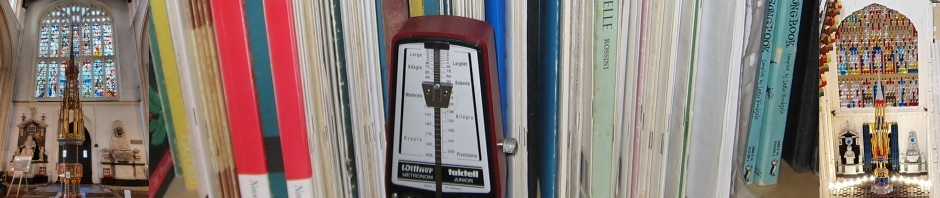
in praise of … the hire score

I have a rule of thumb that if it costs no more than twice as much to buy a score as to hire it, I’ll buy. (This seems to happen increasingly often.) There are advantages to singing from a score you own; you have exclusive control over all markings on it, and can leave in your own personal ones relating to particular difficulties you have. And you won’t have to pay in future to hire it.

But there is some pleasure in using a score that many others have sung from before you. You can for example boggle at some of the peculiar interpretations which your predecessors had to follow, or observe how you are not the first to find a certain passage tricky. At one recent concert our scores of a rarely-performed work were, I estimate, about 60 years old and had accumulated a fair amount of annotation. (As well as using some old-fashioned typography: crotchet rests a mirror image of quaver ones, repeated notes in the accompaniment indicated by slashes, and dots separated from the notes they lengthened. I don’t think I’d ever encountered that last one before.) My score included details of someone’s future travels (to France and New Zealand) on the flyleaf and some instructions (in a different hand) in Welsh!

Posted in category-defying | Leave a comment

A Badminton racket

The title was chosen for the sake of the pun, not because of the sort of noise I think we made! I sang at the funeral of a former assistant priest at a church in Bath, who had earlier been at Badminton, so that’s where the funeral was held. It’s an intriguing little church because it doubles as parish church and family chapel for the Dukes of Beaufort; essentially Georgian but with a Victorian extension to accommodate a huge memorial by Grinling Gibbons (formerly in St George’s Chapel in Windsor). It still has box pews (though not for the choir; I wished we had them as I was sat in a draught).

Our music was straightforward but good quality pieces such as In Paradisum from Fauré’s Requiem and Purcell’s Thou knowest, Lord. This and the dignified language of the whole service made it a gratifying experience to take part and I regretted I hadn’t known Tom Gibson better than I did; he was quite a character.

Posted in funeral | Tagged , , , , | Leave a comment

this blog’s first Mozart Requiem

It was gratifying to sing once again to a full Cathedral for Bristol Choral’s most recent concert. Our first half was a piece I’d never sung before: Handel’s Dettingen Te Deum. I recall this being quite popular on concert programmes in Cambridge, maybe because it is fairly easy to put together including the soloists and sounds impressive. As long as you can get the trumpets of course – the British Sinfonietta’s showed how it’s done.

The second soprano part in this piece gets a certain amount of the infill that is usually associated with alto lines. But there are some highlights, such as the aria-like To thee all angels, which may be intended to compensate for the absence of a soprano soloist.

Few in the choir had encountered the Handel before, but almost everyone had done Mozart’s Requiem. This is the last really major choral work to feature in this blog for the first time. The previous performance of it I sang in, with the Bath Camerata one Good Friday, was just before I started writing the blog, and I don’t think I’ve been to a concert with it in since then. We were told that we should try to erase the interpretations of previous people we’d sung the piece for, and I didn’t find this too hard, not only because of the long time gap but because I think all the performances I’ve sung have been for different people. In particular, I never sang the Requiem for our choir’s previous Director of Music.

Certain passages in this work have acquired associations I can’t shake off. The local hospital had the opening of the Dies Irae on the mixtape which was played to people lying on the slab being measured up for radiotherapy; not really the piece to play to your cancer patients, one might have thought. On a lighter note, the interpretation of the Confutatis by a toy koala is surely definitive; watch this at your own risk! And as I’ve said before I can’t be the only person who cannot sing or hear the end of the Lacrimosa without visualising the closing scene of Amadeus, even if music and film alike are inauthentic.

So how much of the Requiem is Mozart? There are large chunks for which no score in his hand now exists, but was there once more, or was he able to communicate some of his ideas to Süßmayr? Or are we deluding ourselves and everything which is not attested in Mozart’s hand is by Süßmayr in its entirety? Did his proximity to Mozart enable him to raise his game and compose better music than he was normally capable of?

Posted in singing in concerts | Tagged , , , , , | Leave a comment

a view of the marina

The song room at Christchurch Priory must have one of the nicest views of all: across to the inlet of the river Stour where there is a marina full of yachts. I’d never been to the Priory (or indeed the town) when the Cathedral Chamber Choir showed up for a weekend of services.

In amongst more standard repertoire were some pieces I hadn’t done before. I have heard Philip Moore’s Responses countless times on broadcasts but this was the first time I’d sung them and I found them harder than I expected to. A particular difficulty was sorting out crotchets and dotted crotchets in the Lord’s Prayer. Our only ‘early’ piece was the motet O quam suavis by Vivanco. And I hadn’t previously sung Matthew Martin’s Te lucis ante terminum which was nevertheless a fairly straightforward piece to begin the weekend with.

Our communion setting was Darke in E, some of which we sing in Bath, though not the Gloria which has some very exposed soprano lines. Matins had just one canticle, in our case Britten’s Jubilate in E flat. Our parting shot was Stanford’s For lo I raise up, which we’d been deprived of the chance to sing on our last choir tour. We put a lot of work into making this as good as we could achieve; it helped that evensong was late on the Sunday so rehearsal time wasn’t rushed.

It is an interesting building though not hugely resonant – the Durham-like thick Norman pillars see to that. I wonder what the Kaiser made of the service he attended there? I was sorry that all services were in the nave so we never used the historic quire. However, I’m not sure we’d have fitted in to the stalls, or having done so left room for a congregation there, and also a number of the misericords are fragile and in need of restoration. The clergy were much more musically aware than they are in many parish churches (even some ‘major churches’), and the organ sounds lovely after a recent rebuild. (Our organist explored its range of colours during his hymn accompaniments.) Christchurch Priory seems to be off the radar of many visiting choirs but is well worth considering.

Posted in singing at services | Tagged , , , , , , , | Leave a comment

a coachload come to the Bachfest

Stile Antico’s concert at the 2019 Bach Festival in Bath was very well attended. I noticed a coach outside St Mary’s Church afterwards to take people away, and have learned that some local tour companies block-book at popular concerts. This may explain why some of them sell out so quickly, and also the age profile; certainly the audience age at this one was among the highest I’ve seen at a concert in Bath (which is saying something!), based on those people I saw.

I was up in the gallery, behind someone who I think may have been there to accompany his wife. At any rate, he spent much of the performance time in a circular sequence of opening his programme book (a large booklet covering the whole Festival’s concerts), finding the text and translation of the piece currently being performed, studying it, closing it, then opening the programme book to find his place again a couple of minutes later. The easternmost two sets of seats in the gallery weren’t available to us.

This was my third Stile Antico concert, and it consisted of works by Schütz and J S Bach written for funeral or memorial services, well suited to the week of a family funeral. Much of it was accompanied by continuo, sometimes including a theorbo (I am not an early music specialist but I’m now able to tell one of these from an archlute). When I first encountered this repertoire, the prevailing practice was to perform unaccompanied everything which could be so performed, but current attitudes towards accompaniment are more flexible.

There have been changes in personnel in Stile Antico in the last couple of years, but the group still has the chemistry which allows them to keep ensemble and agree on such matters as dynamics without a conductor, even when some of the singers were at one point detached from the rest at the very east end of the church. Schütz’ Musikalische Exequien showed up that their solo voices aren’t as interesting as those of say the Tallis Scholars or the Sixteen, in other words this ensemble is greater than the sum of its parts. The other two motets by Schütz fared rather better, as did the two Bach motets (Komm, Jesu, komm and Jesu, meine Freude). Perhaps unsurprisingly, Stile Antico’s performance practice worked best in those movements in the latter which involved fewer than the total number of singers. I was rather surprised that as far as I could tell the Bach motets were performed at A=440. The encore was Thomas Campion’s Never weather-beaten sail which I think I heard the Tallis Scholars do as an encore in the same place a few months ago.

Guardian review

Posted in going to concerts | Tagged , , , , , | Leave a comment

an icy trip to the Abbey

I picked my way through the icy and barely thawed streets to go and sing evensong at Bath Abbey with the choir of St Peter’s Caversham, visiting for the day. As in October, we were in temporary stalls in the crossing, just west of a partition blocking off the hard-hat area that is the East End. Probably my last chance to look at the pews in the nave!

It was the coldest night of the year so far, and the glowing bars of the electric heater on one side were mainly decorative. Our service music was Radcliffe Responses, Psalm 118:1-12 (ending with 3 verses of the sort that are normally cut out!), Dyson in F and Balfour Gardiner’s Evening Hymn. Bath Abbey discourages introits these days, and we lost our hymn (though it wasn’t a particular favourite of mine!).

We had a loyal band of supporters, and I also supplied a singer to replace someone who’d put his back out shovelling snow. I look forward to returning to the Abbey when the East end is revealed, and when the floor is replaced above the new geothermal heating.

Posted in singing at services | Tagged , , , , | Leave a comment

a new chapter for the South West Festival Chorus

I used to sing quite regularly with this choir, which puts on ‘all-comers’ concerts preceded by intensive rehearsal twice a year. But I haven’t done so since 2013. I dropped out partly because various friends no longer sang in the choir, also I became less confident that the programme wouldn’t be changed after I’d signed up and paid up. Repertoire is an important factor in what I decide to sing in.

The choir has performed under the direction of Rupert Bevan for the last 3 years or so, and now a conductor well known to me is taking over. The first concert under their direction will be Duruflé’s Requiem and RVW’s Five Mystical Songs. I feel a bit Duruflé’d-out at the moment, so I’m passing on this one, but look forward to encountering this conductor in future in a new context. There are some real Bathonian characters awaiting them!

[Update February 2019: the Duruflé concert has been cancelled. I noticed a programming overlap with the April concert of Bath Choral Society. The chorus master I mentioned has dropped out, and I have since had an invitation to sing Gerontius with the choir in the summer, “We’re also recruiting a chorus master”]

Posted in choirs | Tagged , , , , , | 2 Comments

one-church denominations

I apologise in advance that this isn’t really about music, although there is a slight musical angle to it.

On my way to a Lord’s Test match last year I walked along the Regent’s Canal and noticed a handsome church on the other side in Maida Avenue. Later I looked it up and found it is the place where the last regular meetings of the Catholic Apostolic Church are believed to take place. This denomination once had a presence in most English towns of any size (Bath’s church is now the children’s nursery in Guinea Lane) and still has considerable assets, including owning Christ the King in Gordon Square. (The evidence for this can be found in the accounts filed with the Charity Commission.) But its belief in the imminent Second Coming was the source of its near-total demise. According to its rules, priests can no longer be validly ordained, and the last one died nearly 50 years ago.

Maida Ave Catholic Apostolic Church

A glimpse of Maida Ave Catholic Apostolic Church

It was apparently renowned for its music, with its own hymnbook and other liturgical music. Much of this was composed by Edmund Hart Turpin, and how good you thought the music was probably depended on what you thought of him as a composer. A similar situation applied with regard to Edward Wilton Ellis and hymn texts. At this point you realise how lucky the Methodist Church was to have Charles Wesley as its founding hymnographer. But there seems to have been no second generation of Catholic Apostolic Church composers, probably because of the long decline of the denomination through the first part of the 20th century.

So why is there still a congregation? I can think of other denominations at the ‘high’ end of the spectrum which are clinging on with a handful of adherents. The ordination of women has created a number of splinter groups breaking off from the Church of England, which (rather in the manner of Marxist political parties in Britain) have further subdivided themselves into ever smaller factions. There is at least one similar group which has seceded from the Roman Catholic Church over Vatican II. They have few church buildings, although I know of a church in Reading and recall seeing another (which was a former shop) in Canterbury; St Ninians, Whitby has successively belonged to three of these small groups since leaving the Church of England.

Why would anyone choose to be in such a denomination? Especially if you regard its sacraments alone as valid? Why attend a church such as the one in Maida Ave which seems to reject any form of evangelism, even a notice board? I can think of a few reasons:

  • conviction that you alone are right and the rest of Christendom, in particular the major denominations, are in error
  • an attachment to a particular building, congregation or liturgy
  • a chance to have a leading role with an impressive-sounding title
  • satisfaction at feeling that you are one of a very exclusive group
Posted in category-defying | 1 Comment

my top 10 big choral works

January is always a quiet month for performance (although I have one new venture I’ll write about fairly soon) so time to write some more general posts I’ve been saving up for a while.

Singing Mahler 2 near the end of 2017 completed for me what I think of as the canon of generally acknowledged ‘standard’ large choral works. [‘Large’ in the sense of performance time, also that they are works which can be performed by a largish choir, even if they were not written for one.] I now feel I can form an informed view on which are my favourites – the ones that I feel really excited about when I am asked to sing them – because they’re unlikely to be supplanted by anything I’ve never sung. I selected a ‘top 10’ and here they are, alphabetically by composer:

  • Bach, St Matthew Passion
  • Bach, St John Passion
  • Bach, Mass in B minor
  • Beethoven, Missa Solemnis
  • Berlioz, Grande Messe des Morts
  • Elgar, The Dream of Gerontius
  • Mahler, Eighth Symphony
  • Mozart, Requiem
  • Rachmaninov, Vespers
  • Verdi, Requiem

I’m pleased by the range of nationalities and traditions represented here. You might ask ‘Where is Messiah?’, and my answer would be ‘Probably at no. 11’. But I can’t put my hand on my heart and say I prefer it to any of the ten on my list. Others which just missed the cut are Monteverdi’s Vespers of 1610 and Brahms’ German Requiem.

Obviously no two singers will agree on this sort of list. If you want to know what I like about these pieces, you may get some idea from reading my accounts of performances of them here. I have sung all of them within the lifetime of the blog, with the exception of Mozart’s Requiem, which I performed just before I started it and which I shall sing again in March.

Posted in repertoire | Tagged , , , , , , | Leave a comment

Lichfield dedications

For the last few years Lichfield Cathedral Choir have set a themed quiz at Advent and Lent, with a question each day. I have in the past had fun identifying Cathedral choir stalls and music setting the word ‘star’, though I didn’t attempt the organ consoles set in Lent 2018.

Advent 2018 was more tempting; enciphered dedications of pieces sung by Lichfield Cathedral Choir during the year. I wasn’t one of the top scorers, but there were only 3 of the 24 I couldn’t do, and a fourth I solved outside the 24-hour window. I was able to identify every piece for which I deciphered the coded dedication. I took pride in submitting solutions as soon as possible after the questions were released at midnight each day, which kept me up some nights, though never really late! I did the decipherments by various methods: identifying the cipher, looking for the most commonly occurring symbols and matching them to common letters, using dates (where these appeared unenciphered), or trying to find common words such as ‘commissioned’ or ‘dedicated’ and formulaic phrases (a method which has been fruitful in expanding our understanding of Etruscan).

This set me thinking about dedications in general. At least for anthems and service music, they only appear from the end of the 19th century onwards, perhaps because before then people just composed music as it was needed rather than being commissioned. The prevalence of commissions, and the consequent need to be serious, may also be why no one in music seems to have gone in systematically for the sly humour of Nikolaus Pevsner in this area. (Although David Willcocks has had a go: see below). However I have a few favourites, generally those where the dedicator has taken the opportunity to put the dedicatee’s name in virtual lights for a reason other than that they paid for the piece to be written. (And while I am a devotee of a composer who turned dedications into a minor art form, I shall leave Berg out of this post.) I have mentioned before Kodály’s UXORI CARISSIMAE on his Missa Brevis, getting the message out in a way that it would not have been had he written it in Hungarian. Another is Debussy’s gently punning one for his Ariettes oubliées to Mary Garden “inoubliable Mélisande”, so that his opinion of her creation of the title rôle in his opera would forever be on the record. I may add some more to the list as they occur to me. (Here’s one.)

Posted in category-defying | Tagged , , , | Leave a comment

Review of the year: 2018

I don’t think that this was a particularly vintage year, though there was one obvious highlight: singing in Mahler 8 at the Proms. For public exposure that is hard to beat! If there was a theme to the year, it was that it largely reprised Three Choirs 2016, as I got to sing again four of the six pieces I performed then. I sang in Clifton Cathedral for the first time. I made the acquaintance of Will Todd’s Mass in Blue at a Come and Sing, and at last performed Vaughan Williams’ Serenade to Music. From the Cathedral repertoire it was Purcell in B flat, Bach’s O Jesu Christ mein Lebens Licht and Weelkes’ Service for Trebles, amongst other pieces, that were new to me. I sang Duruflé’s Requiem with organ in Portugal, and with orchestra in Keynsham. I’ve also spent more time than I’d have liked bobbing about to try to get a view of the conductor.

Most of the performances I went to were local, either in Festivals or by local amateur groups, although I heard an organ recital at the Proms and another in the Palau de la Música Catalana in Barcelona.

And now for some awards:

Performance of the Year. Mahler 8 with the BBC National Orchestra of Wales in the Royal Albert Hall (see above)

Building of the Year. Winchester Cathedral, where I sang both with the Cathedral Chamber Choir in August and with the Erleigh Cantors in October. I also went to a concert in Prior Park Chapel for the first time. And saw in Barcelona just what can be done with a concert hall when the choir is put at the heart of the design.

Repeated pieces. Nothing really spectacular, but there was Duruflé’s Requiem in its various guises, and at one point I kept encountering Ravel’s Pavane pour une infante défunte.

Mistaken Identity award. Being thought to be French when I sang the Alleluias at a Catalan-language Mass.

Obstructive Fellow Singer Award. The winner of this may well turn out to be the all-time winner. Not content with usurping a place which had been carefully and clearly reserved for a soprano, he took it on himself in rehearsal to relay the conductor’s beat and gestures for the benefit of those of us who couldn’t see that far, and for good measure repeatedly gesticulated upwards if pitch dropped and shushed anyone he thought was singing too loudly. As I couldn’t face an evening next to someone who found fault with my singing every time I opened my mouth – that’s the conductor’s job! – I moved elsewhere for the performance.

Obstructive Fellow Singer Award: runners-up. The trio of sopranos (all from the same choir) at a Come and Sing (not one of Bristol Choral’s!) who decided to monopolise the solos, because of course no one else could possibly attempt any of them. I persisted in singing along with those parts I thought I could do competently – including some passages that their ‘lead’ singer kept getting wrong – so the soprano solo line was always a trio or quartet. It would have been better to divide them between us four (and indeed anyone else who wanted a go), as the altos, tenors and basses managed to do, so that it didn’t turn into a semi-chorus.

What does 2019 hold? I think it might be a year of change in some respects. We are looking forward to having an enhanced organ and new choir stalls in church, but there isn’t a definite timescale for either yet. That is something I’m really looking forward to. There are some pieces new to me turning up in concert, a first visit to Christchurch Priory and the Erleigh Cantors go further north than ever before! And I am going to try and put some more images – at least one a month? – into the blog.

Posted in category-defying | Leave a comment

keeping that candle going

Back in St David’s for Christmas again, and this time we arrived at the Cathedral for 9 Lessons and Carols soon after the doors opened and were able to sit at the back of the nave (next to someone who had apparently been parked there by some fitter companions who sat elsewhere).

I’m happy to report no electrical mishaps interfering noisily this year, although at this and other services I noticed that the heaters near the crossing still intermittently hum noisily. I didn’t fare quite so well with the candle because of a draught from the direction of the West door, so it only lasted till the Seventh Lesson. I thought I’d be all right in the dark with the remaining hymns (all in English), but got slightly floored by one of the less frequently sung verses of O Come All Ye Faithful: ‘Child, for us strangers/Poor and in the manger,/erm er umm umm….’

What of the choir? Along with some standards we had some pieces with Welsh connexions such as a setting of a translation of Es ist ein Ros’ by Meirion Wynn Jones and George Guest’s beautiful arrangement of Suo Gân. I’m sure the Guest would be better known if choirs could get over the language barrier (it wouldn’t be the same in English).

The extravagant improvisations this year took some of their material from L’Arlésienne, or to be precise from the Provençal carol La marche des rois used by Bizet. St David’s clearly sticks to the same Mass settings for the Christmas services each year.

Meanwhile earlier in December we’d included two ambitious pieces in our own Advent carol service: Anthony Piccolo’s I look from afar and I am the day by Jonathan Dove (he likes setting texts about stars!). And I sang one of the O antiphons – gradually working my way round them all.

Posted in going to services, singing at services | Tagged , , , , , , | Leave a comment