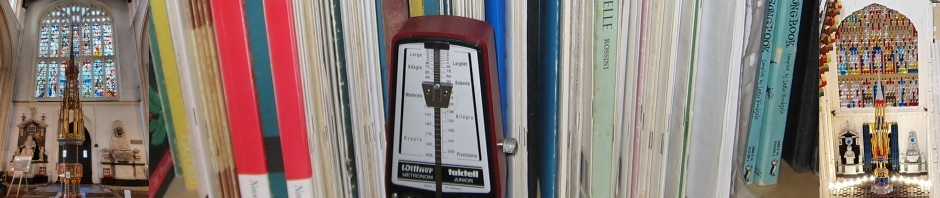
Jingling Johnny at Prom 62

I took my daughter to the Proms to hear Mariss Jansons conduct the Royal Concertgebouw Orchestra in two symphonies: Haydn’s no. 100, the ‘Military’ and Shostakovich’s 10th.

Both of these works have an in-your-face quality, with an occasional need for shrill, piercing woodwind, which the RCO delivered admirably. There was a theatrical element to the Haydn when some of the percussionists trooped off, Farewell Symphony-style, at the end of the second movement. I wondered whether their contracts allowed them to leave if they weren’t required in the rest of the work, but they reappeared at the very end, walking on stage in a line, with the player at the back waving a contraption which looked like a two-tier cake stand covered in bells and with a couple of tassels dangling from it. I gather that the official English name for this instrument is a ‘Jingling Johnny’.

The Turk inspired the Haydn symphony, but in the Shostakovich you can feel the menacing presence of a Georgian. This symphony is very much in favour and frequently performed, while the Leningrad seems to be taking a back seat at the moment. I heard no. 10 at the Proms three years ago, and while that performance was perfectly creditable, this one surpassed it, not least because of the variety of controlled tone from woodwind (especially in the long, rambling solo melodies Shostakovich loves to write) and brass. I think in particular of the final horn call in the solo movement, when I had to look to check that the player really hadn’t moved further away than before, it sounded so distant.

My daughter commented on how restrained Jansson’s gestures were ‘although for a conductor he’s quite young’ (he’s 66).

Encores were Sibelius (that standard encore piece, the Valse Triste) and more Shostakovich. Now where’s the Proms pond in the arena this year?

Reviews (mostly very good) from the Guardian, Independent, Times and Telegraph. Also this, mostly about the Haydn, from the BBC Proms blog.

Posted in going to concerts | Tagged , , , , , , | 1 Comment

the cathedral with the campanile

I believe that Chichester Cathedral is the only Church of England Cathedral in England with a detached bell-tower.* It’s not in the best of shape, being largely covered in netting at the moment. Perhaps it’s awaiting the attention of the Cathedral’s surveyor of a few years ago, Donald Buttress (could there be a better name?).

I spent two days at the end of the Cathedral Chamber Choir’s week there, getting up at 5 a.m. in order to make the Saturday morning rehearsal. I needed every minute because there was quite a bit of new music for me. Firstly a piece from my wishlist, Parry’s ‘Great’ service. This was only published in the 1980’s which may explain its gradual entry into the repertoire. Actually now I’ve sung it I rather wonder why I was so desperate to do so, but at least I have performed it now. The anthem was also one I’d never sung before, although I heard it earlier this year, Bach’s O Jesu Christ, meins Leben Licht.

On Sunday we paired the Vierne Messe Solennelle with an Ave Verum by Dupré, which was also new to me. It felt like a piece for women’s voices which had been rewritten for four-part choir. At Matins and Evensong we sang a recently-written set of Responses by our conductor, Matthew O’Donovan. Chichester does not patronise visiting choirs by cutting down on the full psalms for the day, so we had plenty of psalmody on Saturday. Sunday evensong posed the greatest challenge; we had booked an organist for the Sunday services but during lunchtime he had an accident and wasn’t able to play evensong. We were able to present an unchanged programme, with our conductor now playing the organ and one of our other conductors conducting rather than singing. The anthem was Elgar’s Great is the Lord, which I tend to confuse with Give unto the Lord and which I was singing for the first time, paired with Howells’ ‘Westminster’ canticles. Emergency re-arrangement of this kind is surely one of the greatest tests of a choir!

We stayed at the University of Chichester’s Bishop Otter College campus. It was an all too brief visit, and not as social as usual – I found myself eating alone more than I’d have liked. Not only are shared meals more fun, but this is also when I get a feel for where people would like to go on future visits, which I’m now planning.

*This is no longer true – it has been pointed out to me that St Edmundsbury has a brand new separate bell-tower, and Chester has had one since the 1970’s. On a recent visit to Salisbury I learned that there used to be a bell-tower there too.

Posted in singing at services | Tagged , , , , , , , , | 2 Comments

the Edington Festival: pleasure and sadness

Some friends regularly go to events at the Edington Festival nearby, but I’ve never managed it. This is because it usually clashes with the Cathedral Chamber Choir’s cathedral week and I’m away or not feeling like going to another service. (This year my husband is overseas so I’m needed for childcare).

I enjoy listening to the Festival’s BBC broadcasts though. At the same time, something about the Festival saddens me. It comes over with the impression of ‘bringing music within the liturgy to the West Country where they don’t have it’. It is true that outside the cathedral and abbey foundations round here there are limited opportunities for performing high-quality music during services, especially for adult female singers. But this isn’t necessarily for want of singers.

I think for example of a church near where I live (I have not referred to this church in this blog before) which used to have a ‘special choir’ which met to perform Mass settings and motets occasionally at services. I never had the chance to sing in this choir, because shortly before I moved here there was a change of clergy and the special choir was abolished. I don’t know what goes on musically at that church now.

I suspect that if you gathered the right people together, there would be nothing in the repertoire of the Edington Festival’s choirs that they could not perform, although they might not be able to do it all intensively over one week.

Posted in broadcasts, festivals | Tagged , | Leave a comment

Flesh coloured tights

These were requested as part of the dress code for my weekend of services with the Erleigh Cantors in St. Alban’s Cathedral. We had a busy weekend which began with a wedding on the Saturday morning as well as the usual round of services. The organ has now been refurbished, though it is still the subject of an appeal.

There were three new pieces for me. Firstly Charles Theodore Pachelbel’s Magnificat, which has the distinction of having been performed at the first documented concert in New York City. It is a pleasant piece with a notable Italian influence. On Sunday morning we sang Lassus’ Ave verum, which I was surprised not to have encountered before and look forward to singing again. Finally on Sunday evening came Leighton’s O God enfold me in the sun, a relatively early work with characteristic spikiness and a strong modern text.

Apart from that there were some favourite pieces such as Purcell’s Hear my prayer, Holst’s Nunc Dimittis and my favourite Reponses, Richard Lloyd’s second setting. (We did the final dismissal from them too!) We brought back Michael Walsh’s Mass of the Holy Trinity, with its top B’s for the first sopranos (at least that is a semitone lower than required for the Langlais last year). Wesley’s evening canticles in E are very firmly imprinted on my memory, since I recorded them when I was a student; unfortunately they are also imprinted at the speeds the conductor of that recording chose, so I had to make a conscious effort not to sing them the way I knew.

Our next meeting will be a weekend in Winchester Cathedral in October.

Posted in singing at services | Tagged , , , , , , , , , , | Leave a comment

Deborah

The Chandos Singers paid tribute to the Handel anniversary by performing this early oratorio. It’s a curious piece, based on one of the biblical episodes that you don’t usually hear about in church; not very much judging under the palm tree, but an awful lot of smiting, one of the more significant pieces of which being carried out by my character, Jael.

Many of the choruses are adapted from earlier works such as Dixit Dominus and the Coronation Anthems, sometimes in a rather disconcerting way so that they veer away from the way you thought you remembered that they went. And I think I now understand some of the point of recitative; it is a useful way of warming up before an aria if you haven’t sung for some minutes.

So that’s Handel, Purcell and Mendelssohn honoured this year – I just need a chance to do some Haydn.

Posted in singing in concerts | Tagged , , , | Leave a comment

the 4 part music forum

This has been set up recently by someone I know who runs an on-location recording company, 4 Part Music. He’s keen for people to try it out and to build up a user base. The main subject areas are recording gear, on-location recording, post production, the music business generally, ‘choirs and places where they sing’ and ‘news and events’, where you can promote your own events. It is not necessary for the music discussed to be in four parts – I’m sure threads on plainchant or Spem in Alium would be welcome!

http://4partmusic.co.uk/forum/

Posted in on the Web | Leave a comment

six gunshots

The audience for the ROH’s recent production of Lulu were warned that they would hear these towards the end of the first scene of Act II (though if you don’t already know that this work contains gunfire, you probably also won’t know how long the scene is). What the audience wasn’t officially warned about was that the production dispensed almost totally with a set: costumes were monochrome and apart from a solitary chair, the props comprised a few flowers and weapons, and the portrait (always a bit of a problem) was represented by a beam of light.

This approach divided critics very sharply. The audience at the performance I attended seemed happier; overhearing the comments in the intervals, I detected some Bergnot, but not people asking ‘Where’s the set?’ It’s not the most eccentric staging of the opera that I’ve seen (that was in Hannover a few years ago). Generally speaking I was in favour of this approach as I would rather have less than more distraction from the stage; and there really was plenty of colour – but it came from the orchestra pit.

However, there were times when the lack of props did obscure the action: for example when Lulu delivers her object lesson in how to deal with a commitment-phobe by getting Dr Schön to write a letter breaking off his engagement. And because so much was sung with singers facing directly forward into the stalls, you felt a bit short-changed if you were round the side of the circle, as I was. (Memo to ROH: you need to fix the display of umlauts on the back-of-seat surtitles).

I don’t have much to add what reviewers have said the performances, which coped well with the constraints described above. I would like to single out one minor piece of luxury casting: Philip Langridge, who made the Marquis unbearably creepy.

The production was reviewed all over the place, and I’ll select just a few here, from the Guardian, Telegraph and Independent on Sunday. But discussion spilled outside the usual boundaries: the Spectator printed two reviews, one for and one against, and Guardian readers contributed their opinions.

The performance I attended will be broadcast on BBC Radio 3 next Saturday evening. (The bloodcurdling scream and weapons-grade dissonance in the trailer are not typical of the opera as a whole!)

Posted in opera | Tagged , , , , , | 3 Comments

a quiet June/July

I seem to have been going to concerts more than performing in them. This part of the year is quieter than usual and there are various reasons, among them a couple of concerts I might have sung in and didn’t. In one case I realised that I just wasn’t going to be able to get to enough rehearsals. In the other I was asked to note the date of the concert, but only when the day of the first rehearsal came and went did I realise that I wasn’t needed to sing in it. So my next outing is a concert in mid-July.

Posted in singing in concerts | 1 Comment

National composers

I can’t get much of a musical angle on my recent short trip to Norway. I didn’t for example see the new opera house in Oslo or attend a church service (this country provides plenty of work for organists). Another thing I might have done and didn’t was to visit Grieg’s house at Troldhaugen near Bergen. However this started me thinking about how countries treat their national composers (that is if they have just one – some are spoiled for choice). If Britain has one, Elgar just beats Purcell for the title. Like Grieg, he’s remembered (apart from actual performances of his music) in a rather understated sort of way, apart from contributing to the local tourist industry in the area where he lived. My father once claimed to have seen the ‘Elgar Tyres and Service Station’ or similar near Hereford, though we think that may have been just a local firm with the same name.

I have I think only performed one piece by Grieg – his Ave maris stella – though my alarm clock plays Morning from Peer Gynt, so his music (in a synthesised form) is often the first thing I hear on waking.

Posted in category-defying | Tagged , | 1 Comment

the LSO Chamber Ensemble

The day after my trip to the South Bank, I was back in Bath to hear Nikolaij Znaider and the LSO Chamber Ensemble play two string sextets: Schoenberg’s Verklärte Nacht and Brahms’ first sextet.

I heard the Schoenberg when it was last played in Bath a few years ago by the Vienna String Sextet. I felt that in both pieces there was a tendency for the other players to defer to Znaider on first violin, and they seemed rather less at ease in the Schoenberg (both the sound and the body language of the players suggested this). However the Schoenberg performance was what I took away with me, perhaps because the Brahms just isn’t that interesting a piece. Or maybe after hearing lots of early 20th-century Vienna I’d reached saturation point.

The concert is available still on BBC Radio 3’s Listen Again, though I notice that they reverse the order so that the Brahms precedes the Schoenberg.

Posted in booking visiting choirs, going to concerts | Tagged , , , , | Leave a comment

City of Dreams

I was back at the Royal Festival Hall on May 28th for another programme combining Berg and Mahler, in this case the Violin Concerto (with Christian Tetzlaff as soloist) and the Sixth Symphony, conducted by Esa-Pekka Salonen.

I last heard the concerto in a Proms performance some time ago, but the Royal Albert Hall acoustic tends to blur the detail – now I could hear it all in the much drier ambience of the RFH, along with the corrections which have now been made to the score. The interpretation was at the more restrained end of the spectrum, and was really all I could have wished for.

I wondered what my reaction to Mahler 6 would be. This particular symphony seems very much in favour at the moment – even my local university orchestra has been playing it – and my usual reaction to it is to wish I were listening to Berg’s Three Orchestral Pieces instead. Would I still have the same reaction at this concert? I did, and after the very subtle orchestral colours that I’d just heard in Berg’s music the Mahler seemed garish by comparison. Perhaps a visual counterpart of this was what happened to the harpist. In the concerto the harp was unusually positioned directly in front of the conductor, in the middle of the strings; in the symphony the harps (now two) were in their usual location between violins and percussion.

I should add that my comparison is a comment on the work, not so much on the interpretation. I was probably in a small minority in not having come mainly to hear the Mahler (though my neighbour appeared to fall asleep in the final(!) movement of it). Like some others, I was also unconvinced by the slow movement being played third. (In general I think that Mahler’s second thoughts tend to be improvements). It seemed to make the first part of the symphony too relentless.

This symphony is also famously the one with cowbells in, and I believe the first work to make use of them. Did Mahler borrow some cowbells off a local farmer to add to his array of percussion? And is there now a standard orchestral cowbell? I noticed that one of the horn players had his own call afterwards – presumably this was the one who changed the chord from major to minor in the ‘motto’ theme (a bit like singing second soprano in Stanford’s Beati quorum via).

The concert was reviewed in the Guardian, Times and Sunday Times. Also in The Classical Source, a site new to me. At the time of writing it is still available on BBC Radio 3’s Listen Again.

Posted in going to concerts | Tagged , , , , , | Leave a comment

Some concerts from the 2009 Bath Festival

I will mention these briefly, as I passed up the opportunity to go because of a residual tickly cough, and let others in the family hear them instead.

First up were the Jerusalem Quartet, playing Haydn Op. 77/1, Bartók’s fourth quartet and the Debussy quartet. The comment that I got back was that these three diverse pieces ended up sounding rather too similar to one another! We expected our daughter to like the Bartók most, but she preferred the Debussy.

Carole Cerasi played the first book of the Well-Tempered Clavier on a clavichord in the Guildhall, in two instalments. The Guildhall lends itself well to this type of concert as even quiet sounds carry from the platform right through the audience. This was well worth the investment of going to two concerts in one day.

I heard Freddy Kempf last time he came to the Festival. I was rather worried after his account of the Appassionata sonata then that he would beat the Pathétique black and blue, but I’m told that he was more sensitive. The Liszt pieces in his recital, played in a different order from the programme, came off best; the Chopin was less successful.

The Guardian reviewed Kempf and Cerasi here. A review of the Jerusalem Quartet can be found on The Classical Source.

Finally, to anyone who has been visited Bath for the Festival, I should add that even Bath’s traffic isn’t normally as gridlocked as it has been in recent days. A vital road has been blocked by the discovery of a damaged water main, and this has added to disruption caused by building work on the new bus station being at a critical stage.

Posted in going to concerts | Tagged , , , , , , , , , | Leave a comment