in praise of … the filler

Why did Schubert never continue his Quartettsatz D703? Did he get distracted? Run out of inspiration? Or was he prescient enough to think ‘One day people will be able to preserve performances on a medium lasting about an hour, and they’ll need something to fill up the time after one of my other works’? Because that’s how it ended up being used.

Our collection of LPs includes no fewer than five recordings of this work (although the two by the Smetana Quartet are probably the same). It’s a filler for Death and the Maiden, the Trout Quintet, the Quartet D87, Dvořák’s quintet op. 81 and Dvořák’s Quartet op. 105/Terzetto op. 74.

Some works just lend themselves to being used as fillers. We have two accounts of Beethoven’s Leonore overture no. 3 (both on recordings of one of his symphonies). And two each of Dvořák’s Scherzo capriccioso and his overture ‘My Home’. The classic filler lasts about 10 minutes.

However, you don’t get the filler so much on CDs. It’s that extra 20 minutes on the disc. There are many more works that last just under the hour than just over it, and that leaves room for a more substantial piece lasting 20-25 minutes or so, which hardly counts as a filler.

Posted in recordings | Tagged , , | Leave a comment

grounded over Easter

As I write this I’m listening to Bach’s St John Passion on Radio 3. I always try to hear the BBC National Chorus of Wales when they are broadcast (as they have been quite frequently recently), at least so if I am ever an ‘extra’ in one of their concerts there is a talking point with other singers. And my last performance in concert was of this very work.

Bristol Choral Society has had another ‘virtual’ rehearsal which I joined for the first part. We started work on autumn repertoire, using a digital recording of the notes as a backing track. Some of us have discovered one advantage of rehearsing this way – we can happily sing along to the solo parts in whatever voice with impunity. Unfortunately when the recording was relayed to us directly through Zoom rather than via the loudspeakers in our conductor’s home, I couldn’t both hear it and see the score on another application, so I had to drop out at that point. (I was standing at a music stand with a tablet balanced on it, so a second device wasn’t really an option).

Over at church, we in the choir are going to try to record a couple of hymns for Easter Day, one voice at a time over a backing track and then have them edited to sound simultaneously. I haven’t tried recording mine yet – somehow it didn’t seem right to do so before the evening of Good Friday.

Posted in singing - other | Tagged , , | Leave a comment

see you on the other side

Some kind of order is beginning to emerge out of the chaos. Bristol Choral Society has started having online rehearsals. Messages about ‘virtual choir pubs’ and ‘virtual pub choirs’ are dropping into my inbox, and social media is full of people posting recordings of themselves or others playing favourite pieces. On Twitter, I’m following the ‘World Cup of Evensong Canticles’, where canticles settings are pitted against one another for us to vote on. I’ve even dared to sign up to sing in a concert in the Cheltenham Festival in July. [which was cancelled the day after I wrote this]

The online rehearsal works by muting us all on Zoom, so we can see and hear our conductor but hear only ourselves. We do get some feedback from her because she can comment (for example) on posture and mouth shape in our warm ups. Just for fun we are sometimes unmuted in the final few bars of a piece so we can enjoy the variety of time lags. There are entire virtual choirs springing up but I’m content to keep on with my solo practice otherwise.

I wish I’d started following the World Cup for canticles earlier, because I’ve enjoyed weighing up the merits of one setting against another. Mostly I come to a decided preference quite easily, unless there’s been a setting completely unknown to me (and I only want to vote when I’ve sung both canticle settings – just listening to them isn’t enough). A few have been genuinely hard to decide. Surely Byrd ‘Great’ vs Howell’s St. Paul’s would go to penalties? As for Sumsion in G and Darke in F, that has what a local freesheet once described as ‘no-goal thriller’ written all over it.

Beyond this is the uncertainty of what happens when choirs restart. Any kind of hiatus in the usual pattern of concerts can be risky. People will be out of practice at singing with one another and possibly with singing generally (though the virtual choirs are trying to ensure that doesn’t happen). And there is the risk of what happened when the Brandon Hill Singers changed conductor; a loss of singers to other choirs.

Posted in singing - other | Tagged , , , , | Leave a comment

in praise of … choir committees

I’ve not spent a lot of time on choir committees, or ever had one of the more demanding posts. It’s a truism that they deserve lots of gratitude for what they do, and only if you’ve been behind the scenes on the preparations for a concert do you realise just how many and varied are the tasks needed to make it happen and how much effort they require.

But that isn’t all that’s good about these committees. In many choirs the musical director is answerable to them about non-musical matters and this ensures fair treatment, and a body to appeal to if things go wrong. Elsewhere, there are the committees which exist only to do the musical director’s bidding, or in extreme cases are even more closely associated with them. I once had an unsatisfactory audition with a (now recently deceased) conductor, was put on a waiting list and later tried to audition again. I rang the ‘choir secretary’ at home and ended up speaking to the conductor again! I hadn’t realised they were married to one another. No chance of complaining of an unfair audition procedure there.

I am sure that sometimes the committee can be taken over by a clique, and obviously people who have it in for specific other singers shouldn’t be allowed to abuse their powers. It is a sad and unhealthy thing when back-stabbing creeps into a choir; that is why I’m no longer singing with one cathedral-going outfit I used to enjoy. But as far as I know no committee I currently deal with has these issues.

My first experience of being on a choir committee was that of the Kodály choir when I was an undergraduate; in those days the choir was about 150 strong. I started off with the most thankless post: that of membership secretary. There were two difficult aspects to this. One was telling people they could not sing in the concert, once they’d missed too many rehearsals. I had some pro forma notes to send out warning singers, then dismissing them and asking for the return of their score; but there was also a sheet of messages to tenors inviting them back even though they’d previously been sacked! The other hard task was collecting scores from people who had not returned them; inevitably they were living in digs at the far end of Iffley Road or somewhere equally inaccessible. (However dropping a note in at the digs if the former singer was out almost always resulted in the score coming apologetically back.) I graduated to choir secretary, a post I held for two years during what was a turbulent period in the choir’s history, which made for some interesting sets of minutes.

These days I’ve moved on to making venue bookings for one choir and doing some social media for another; close enough to the more responsible tasks to appreciate the work involved.
Posted in choirs | Tagged , | Leave a comment

a grounded singer

So I’ve temporarily lost all my choirs, including the church one. What do I do for singing?

I’d normally try to sing every day, which means individual practice on the days when I have no rehearsal or performance. Now that practice has to be daily and is the only singing I’m doing. Only I don’t have any choir repertoire to work on. I’m starting by brushing up some vocal exercises, which I usually tend to skip over in order to get to the juicy repertoire. I realise with one thing and another I’ve barely been required to sing above a G for several months (apart from the occasional descant in church) – not since the German Requiem in the autumn, which has left me a bit rusty in that area, and generally I mustn’t get out of practice. I’m digging out some of my old books of exercises – Vaccai, Herbert-Cesari, Lütgen’s Die Kunst der Kehlfertigkeit (don’t you just love that word) as well as some choice selections from choir warm-ups (one-one-two-one-one-two-three-two-one-one-two-three-four….) and ones used by past singing teachers which I keep either in my head or on tatty sheets of paper. I’m rather surprised at which ones are proving to be useful to me, but this is a personal thing so not likely to be of interest to my readership.

I’m also slowly working through Ida Carroll’s Advanced Sight-Singing Melodies, which are quite tricky as they were for diploma students – it’s gratifying if I get one right all the way through. Then I’m singing through the soprano parts in some of the anthems in Novello’s Tudor Anthem book, many of which I’ve never sung. Indeed I’ve never come across a choir with a set of copies of this anthology. As the weather warms, and inspired by what Italians have done, I’m opening the window for some of this.

Meanwhile I am progressing putting the LP collection we have inherited on to CD. It has been quite a long haul, partly because the records haven’t always been in good condition and there’s been a fair bit of click removal and cleaning necessary.

Posted in recordings, repertoire | Tagged , , , | Leave a comment

the last concert for a while

I rejoined Gloucester Choral Society to perform Bach’s St John Passion, after thinking carefully about the amount of time and travel involved. I shall never regret doing this, because of the significance that is now attached to it. By concert day (March 14th) concerts were beginning to be cancelled for fear of spreading coronavirus, but this one survived. A couple of days later the curtain was rung down on all performing arts and at the time of writing I’ve lost three concerts, a choral workshop, a Cathedral weekend and numerous church services. In retrospect the Bach is likely to seem a particularly poignant event.

I last sang this work only three years ago but in English, so had to concentrate hard on the German text. At least from my place in the front row I had an uninterrupted view of the conductor. Our orchestra was the Corelli Orchestra – no theorbo in this perfomance, but we did have an oboe da caccia and I think an oboe d’amore appeared briefly too.

Should my path cross again with that of our bass soloist, Greg Bannan, I’ll try to compare notes as a fellow Reading fan. (This Saturday’s match had already fallen by the wayside.)

Until live music returns, I shall have to hold this concert in the memory, along with other recent ventures: the Bristol Choral Society recording; hearing Simon Rattle conduct Berg and Beethoven; being part of a visiting choir for Evensong at Bristol Cathedral; learning Byrd’s Great Service and choruses from Dido and Aeneas; attending Christmas services at St Davids; as well as the more local pleasures of going to Bath Opera and singing an anthem and a few hymns on Sunday mornings.

Posted in singing in concerts | Tagged , , , , , | Leave a comment

Fidelio before the curtain fell

By early March tickets were beginning to appear for events that had originally sold out, as people became anxious about the risk of contagion. One such ticket was a good (and hence expensive) one for Fidelio at the Royal Opera House, which my husband snapped up for the end of a day when he had to visit London.

The main attraction in this case was the stellar cast with Jonas Kaufmann and Lise Davidsen. The latter is new on the scene but is the real deal vocally and can act convincingly. She was also the tallest person on stage, not so much of a problem here in what is largely a trouser role. Kaufmann is always worth hearing, although in fact his role is not so large. Georg Zeppenfeld made Rocco into a convincingly complex character. The singing was of a high standard throughout, and Pappano’s generally fast tempi worked.

The production however was rather odd. The period was uncertain though Tricolors were in evidence, perhaps left over from Andrea Chénier? In the second part Florestan was chained to a rock while the chorus sat around in semicircular rows of chairs, rather as in WNO’s Moses und Aron. More distracting was the projection behind of individual faces from the chorus. This sort of use of the backdrop is very much a current fashion in opera, but has to be handled carefully.

You can catch a broadcast for another month on BBC Sounds.

Posted in going to operas | Tagged , , , , , | Leave a comment

Oh, Jemima!

I missed going to Bath Opera last year, but this year they won out over the concurrent Bach festival and I caught their production of Gounod’s Faust. This once-popular opera is now a relative rarity. It’s a long work, even without the ballet interlude. It was performed in English but with the originally spoken lines set to music.

I shouldn’t really find fault with Gounod because he didn’t do as good a job as Berlioz with this story. (Bath Opera did in fact tackle Berlioz three years ago.) Bath Opera showed their usual skill with low-budget special effects, and this time the projects on the backdrop worked smoothly. The chorus had much to do and handled their various roles and dispositions around the stage (and auditorium!) with aplomb.

In my copy of Kobbé there are two photographs of great singers playing Mephistopheles. To judge by them, you wouldn’t trust Chaliapin to tell you the time of day, while Pol Plançon looks like a much more seductive Prince of Darkness. John DesLauriers leaned towards the latter approach. (As perhaps did the singer my late father-in-law encountered in the interval of a performance many years ago in New York; Mephistopheles came front-of-house and asked him for a light, evidently not having enough of the fires of hell at his command.) Robert Felstead took the title role for Bath Opera and among the other soloists I would single out Hannah Drury as Marguerite.

The raffle at Bath Opera performances is generously stocked; no alcohol winnings this time but I didn’t leave empty-handed.

Posted in opera | Tagged , , , , , | Leave a comment

a belated return to the Barbican

It’s a long time since I visited the Barbican Centre – not within the lifetime of this blog. Even longer ago, I performed there, with the Tallis Chamber Choir (two concerts: Britten’s St Nicholas + carols, and Mozart’s Mass in C minor). Time for a return visit at the end of a day-trip to London to hear Simon Rattle and the LSO, in a pairing of two works about facing death.

I timed my visit to coincide with this concert as it included Berg’s violin concerto played by Lisa Batiashvili. Rattle is noted as a conductor of Berg – I heard him conduct the Three Orchestral Pieces once at the Proms, which made a sufficiently deep impression that some years later I tuned into Radio 3 during a re-broadcast of that performance and was able to identify it as the one I’d been to.

This performance was on the subdued side; sometimes the soloist seemed subsumed in the orchestra (and not just where Berg asks for this effect), although the orchestra was not as large as some I’ve heard in this work. (It tends to get paired with Mahler symphonies.) Perhaps my location near the front and a long way round to the left contributed to this. I would have described it as delicate except for the rather harsh tone she adopted at times. I’ve never heard a performance where the clarinets which introduce the Bach chorale sounded more like an organ or harmonium.

I have more familiarity than most with Beethoven’s Christ on the Mount of Olives, as years ago a Beethoven-loving friend lent me a recording for a few weeks and I wondered why it didn’t appear more frequently in the concert hall. Evidently it was once more in the repertoire, as the castrato Alessandro Moreschi was acclaimed for his performances in the late 19th century. (So he must have been pretty good, though presumably the chance of an outstanding castrato arising dropped as the practice became rarer.) The writing for the Angel in particular is florid coloratura in a way that Beethoven’s writing for voice (and for instruments other than piano?) usually isn’t, and somehow I felt that the style didn’t come naturally to him. I’d be interested to sing the choral part one day, though the men have more to do. If you had the resources you’d ideally want a double chorus of men, as they have to swap quickly between being Jesus’ disciples and the soldiers who have come to arrest him.

Reviews:

Posted in going to concerts | Tagged , , , , , , , | Leave a comment

Ho ho ho ho ho ho

I get to about half of the BCS Come and Sing events (there’s one every year, invariably sold out). I made a point of getting to this year’s, on most of the choruses from Dido and Aeneas. I’ve never performed this work, apart from a concert in Birmingham years ago which included a couple of these choruses. I’ve been to a few performances though, most recently just before I started this blog. I’m told that a recent staging in St Petersburg was a sell-out, though I think the amount of flesh on view in that production may have had something to do with it.

With a score in my hands I was able to study the history of Dido in a bit more detail. I hadn’t realised that some of the music is missing (we know because we have the complete libretto), explaining a feature which as a classicist I am bound to notice: the absence of the gods. Phoebus and Venus appear in a masque which originally began the work, but was not used in the abridgements which are our source for the music. The odd postlude which I heard at the end of the last performance I went to does in fact go back to the first performances of the piece. It’s dated more than the rest, though! And what about the girls’ school this was written for? Thinking of my own (all-girls) school, I found this hard to believe – but it turns out the school was run by a dancing-master with theatre connections, more like the equivalent of the Royal Ballet School or even RADA or at least the spare-time performing arts coaching which flourishes today. In which case the description of it as a school for young gentlewomen might have been talking it up, socially speaking; these girls were being trained to appear in the theatre in a year or two. Actually come to think of it my school too has produced some notable actresses.

We worked on the choruses during the day, including getting our witches and drunken sailors to sound convincing, and gave a cut-down performance with soloists and piano accompaniment at the end of the afternoon.

Posted in singing - other | Tagged , , , | Leave a comment

have I sung everything in the Oxford Book of Tudor Anthems?

I recently claimed that I had, but that claim isn’t quite true. There’s one anthem that I’ve never sung, and it’s probably the least performed in the book: Byrd’s This day Christ was born. The problem is that it really is specific to Christmas Day. I haven’t even heard it performed by others. I noted this back in 2004, when I performed another rarity: Let God arise by Weelkes, little done I suspect because of its length. My near-complete coverage of this book probably has two causes: the choir at Little St Mary’s Church, Cambridge had copies and made a lot of use of the shorter anthems, and the Erleigh Cantors have systematically been exploring the longer ones.

I have a copy of another anthology of Tudor anthems, edited by Lionel Pike and bought from the closing down sale of a rather short-lived sheet music shop in Bristol. It doesn’t seem to have caught on, despite containing some of the more obvious omissions from the Oxford volume, such as Byrd’s Laudibus in Sanctis and Tallis’ O Lord, give thy Holy Spirit. I’ve never actually sung from it.

Posted in published music | Tagged , , , , | Leave a comment

a weekend with Mathias

I had a busy weekend with two extra services, both of which included anthems by William Mathias.

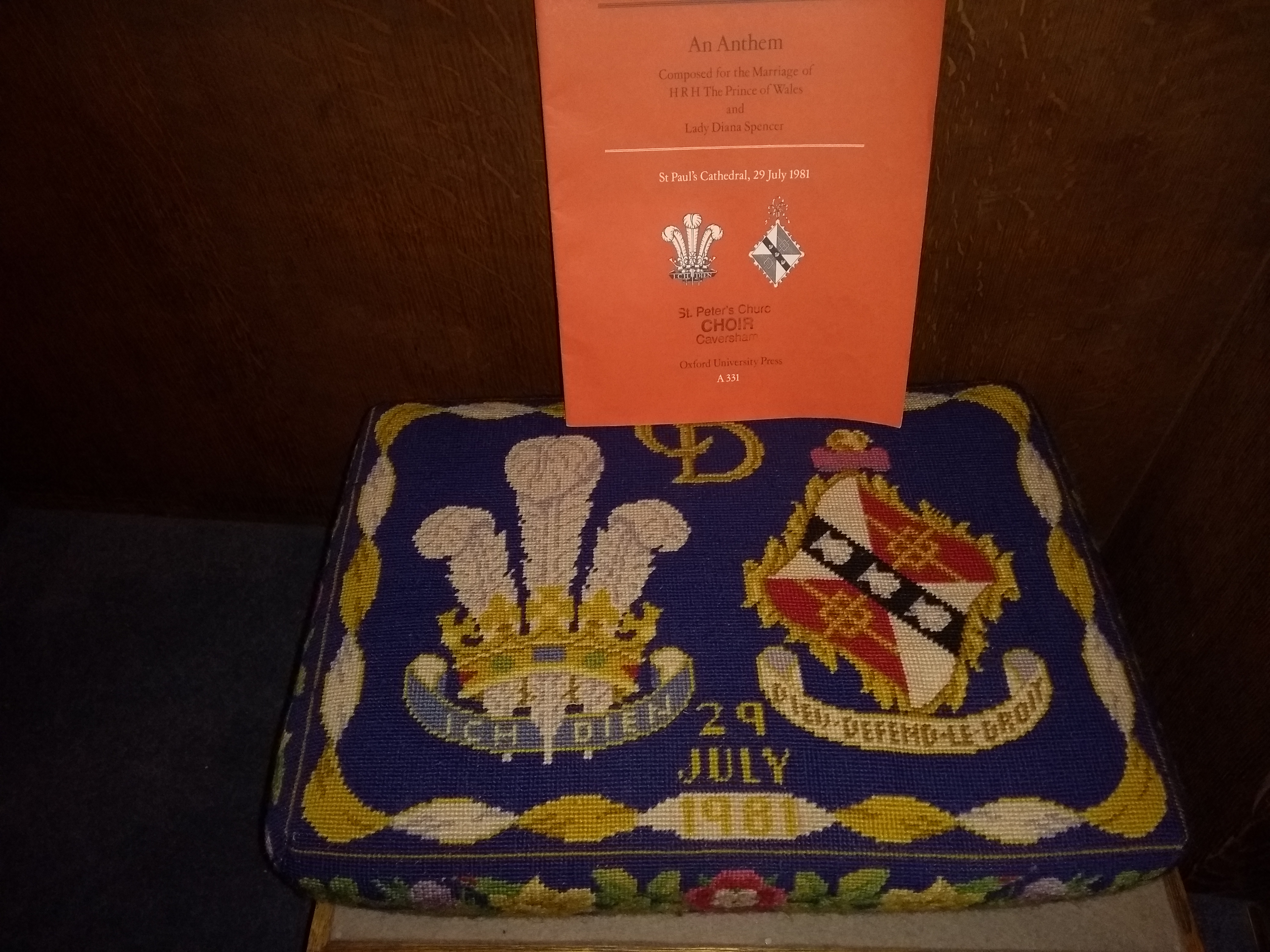
An appropriate kneeler for our anthem

An appropriate kneeler for our anthem

On Saturday I revisited St Mary Redcliffe for the first time in several years, to join a visiting choir for the first Evensong of Candlemas. Our music included Eccard (from the ambulatory), Neary responses, Wood in D and Mathias’ Let the people praise thee O God. There was a final chance to see their Christmas decorations, including a nativity scene within the main altar and a huge suspended wreath, before the season for them ended. Kudos to the Redcliffe folk for providing us with tea, biscuits and cake before we sang.

On Sunday evening we had an extra service of hymns, anthems and readings for Candlemas at church, which included Mathias’ Lift up your heads, Ola Gjelo’s Ubi Caritas, O Nata Lux by Lauridsen, and the inevitable Eccard. An occupational hazard of Candlemas is dealing with lighted candles. We juggled ours carefully while singing the Nunc Dimittis from Howells’ Coll. Reg. setting; extra tricky, firstly because we do not yet have our new choir-stalls so we had to hold the copies in the non-candle hand, and secondly because this is one of those settings where you have to turn back to the Magnificat for the Gloria…

Posted in singing at services | Tagged , , , , , , , , , | Leave a comment