Portsmouth to the rescue

We are now beginning to see which Cathedrals have been hit hardest by the loss of revenue in 2020. I’d made a booking for a choir to sing for a week in Salisbury in 2021, and this week got a letter from the Cathedral saying that it would have to cancel all bookings from visiting choirs. The reasons were partly logistical – understandably as their choir room is awkward to get to at the best of times, although on some previous visits we have rehearsed elsewhere. But the letter made it clear that visiting choirs were being scrapped for the moment as a cost-cutting measure. It’s worth noting that Salisbury has lost tourism revenue not just as a result of the 2020 pandemic, but also in the wake of the Novichok poisoning there in 2018. Other Cathedrals are having to make cutbacks, although I don’t know of any which have done so by stopping visiting choirs.

Fortunately Portsmouth Cathedral had a vacancy for a choir for the week we had booked at Salisbury, and we are not the only Salisbury refugees they are taking on. In fact we had been scheduled to go to Portsmouth in 2020, so the rearranged week (if it happens as planned) will please the choir members who were disappointed this year.

Posted in booking visiting choirs | Tagged , , | Leave a comment

Choir returns (2): Bristol

Bristol Choral Society has in one sense had less of a break than in many years. Very often we’d do nothing after the concert in June until the AGM at the beginning of September, but this year we carried on with remote rehearsals on Zoom in July, some of which were opened up to a wider public as choral workshops.

I realise sadly that I did not sing a concert with the choir at all in the 2019-20 season. I did perform with it because I sang on our CD recording (that’s for another post). It’s not clear when the next concert will be, but after a lot of discussion – including a session where choir members could see the committee inspecting the rehearsal venue – workable ideas about how to meet have emerged.

Those of us who wish to come to rehearsals have been divided into two groups, and I was in the first one to meet. We have a different venue from last year, and are lucky that it is spacious enough for a sensible one-way system, and also to allow us to queue inside before we are let into the rehearsal space. The proceedings are webcast for the benefit of choir members at home.

We are still feeling our way and in particular it isn’t clear yet whether rehearsals will be weekly, or less frequent but longer. Used to being in small groups, I am not bothered by being some distance from other singers, but this week we sang music familiar to me. The real test will come when we learn the new pieces written for our carol competition – again a topic for another post.

I am full of admiration for the way we have managed to work around the difficulties (so far!). They come on top of the difficulties in planning programmes created by the delay in reopening Colston Hall (now the Beacon) – this was running two years behind the original date even before the pandemic.

Posted in choirs, singing - other | Tagged | Leave a comment

Choir returns (1): church

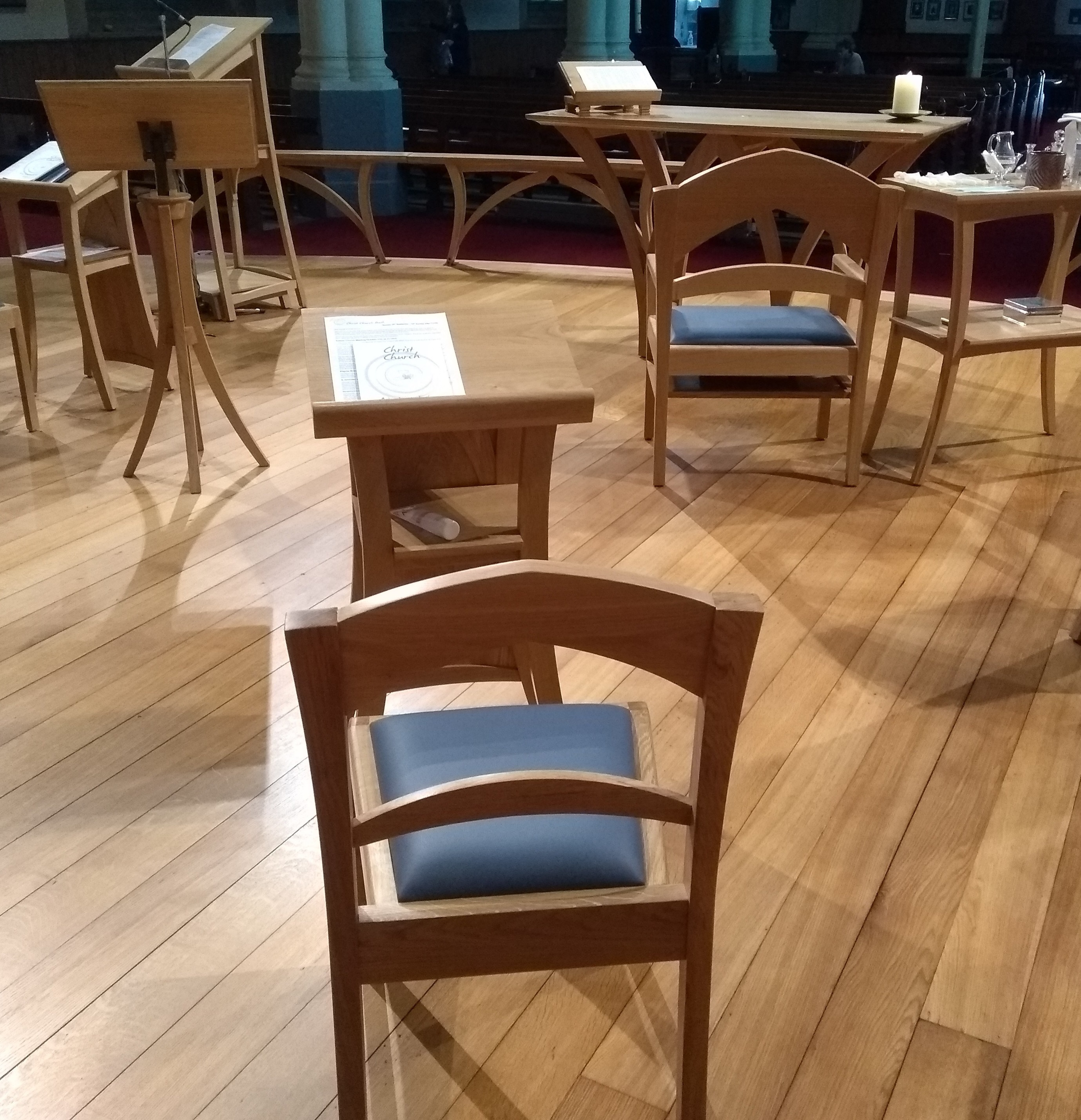
choir seating

Some of our new sanctuary furniture including choir seating

A few weeks after our church services resumed, we have a live choir again. Not only that, but our new choir furniture arrived on the day of our first rehearsal, to join the altar, lectern etc. which appeared earlier in the summer. Usefully, we went for individual seats rather than stalls, so we are carefully separated by 2 metres. I have a seat directly behind the altar, giving me a view out through our glass doors (the previous major project in church), and also a glimpse of the bell-ringer who tolls after the others have come out of the ringing chamber.

The wooden platform the choir stands on has been built out, partly in order to accommodate larger ensembles in concert, and this together with the removal of soft furnishings in church means we also now enjoy a more resonant acoustic. (Although when runners and kneelers return post-pandemic it may dampen down again.)

We sang a hymn, a congregational communion setting (without congregational participation) and a straightforward anthem. Our congregation for the first choral service was not far short of its normal Sunday size and clearly appreciated having live singing even if they couldn’t join in.

Posted in singing at services | Tagged | Leave a comment

crowdsourcing a music list

I’ve never been involved before in a project to crowdsource transcriptions. But I’ve long thought that Cathedral music lists would be a potentially valuable one. I even at one time tried to devise a TEI schema for them.

So I was delighted to be invited to play my part in transcribing Lichfield Cathedral music lists from the mid-19th century. There is a sensibly laid out interface where you choose a day of the week and are then offered a series of pages with that day highlighted and a form to fill in. You can do as much as you like – time prevents me from doing very many but in odd moments most weekends I transcribe a few; it’s more productive than frittering them away on the internet. The transcriptions are double-checked and there is a leader board of participants ordered by their number of correct contributions.

Cathedral music was very different then – sung Mattins every day with the Litany regularly. No breaks for school holidays, although the Cathedral was closed for cleaning for a week in September. No settings of the Responses, and the Canticles appear to have been sung to settings that have sunk without trace, by composers now known only for Anglican chants, if that. Anthems are almost all on scriptural texts (apart from some settings of Collects) and in English. There’s not a huge sense of seasonal appropriateness – Christmas music for example turns up at other times of the year – and the custom of having more sombre repertoire on a Friday had not yet begun, although Fridays were commonly without organ. Nor are ‘big sings’ reserved for weekends. The anthem repertoire still relied heavily on the 18th century (I’d guess that the library had a set of Boyce’s Cathedral Music anthology) and also included many movements from oratorios. There is some music by Purcell and his contemporaries, and by Tudor composers, but it is limited, presumably because of a lack of printed editions. It is sad to think of the pieces this choir could have sung and didn’t! I look forward to searching the resulting database to explore these generalisations further.

Posted in singing - other | Tagged | Leave a comment

tentative returns

September approaches and with it the normal start of the choral season. Three choirs I sing in have indicated that they are making moves to resume rehearsing around the middle of the month. In each case, it’s not clear yet quite how it will work. Who will be there? How will we be arranged? What repertoire will we be doing? How long will we rehearse for? When are we likely to perform, and under what conditions?

It is clear that we will have to stand at some distance from one another. For singers used to standing close together in rows of their part, this will be quite a departure from the norm. With my chamber choir background, I am more used to not relying on my neighbour for notes and leads. The Exultate Singers in particular sometimes sang in a widely spaced circle surrounding their audience. Even Bristol and Gloucester Choral Societies have been known to rehearse familiar pieces ‘scrambled’ with the parts mixed up. Singing spaced out will nevertheless be a test for all of us, although hearing your neighbour at a distance is better than not hearing them at all in a Zoom rehearsal. Other forms of reliance, such as getting a page number you have missed, will also not be possible. I’m thinking of it as an opportunity to learn new skills or improve those I already have.

One advantage though: I won’t have to worry about whether I’m wearing any perfume at choir. If another singer is near enough to be bothered by it, they are too near me!

Posted in choirs | Leave a comment

a choir returns in Milan

We managed to escape the UK for a short break in Italy and I was able to get to Sunday Mass in the Duomo in Milan (which has featured before here). They are keen to make you pay to see the interior of the building but there is an unmarked entrance at the north-west corner for worshippers to enter by at service times. The service took place at the main altar under the crossing and I sat in the nave.

There was a small all-male choir of nine or ten singers, of lay-clerk standard. They sat in the north transept behind a screen (blocked from my view by a pillar) and sang a motet by ?Monteverdi and a Mass setting as well as plainchant. They were miked, which I hope was just because they were few in number, although they didn’t need it. The building is sufficiently spacious that they were well away from both congregation and clergy (there were 10 of the latter, three of whom executed 360° swings of the censer during the service. I suspect being able to do this is a qualification for admission to the Chapter.)

That afternoon I took a train out of the city to visit the Certosa di Pavia. The monastery church boasts some very impressive marquetry choir stalls. I’m sure this building would be a good place to record (though I don’t know what the organ is like) with a resonant acoustic and isolated location away from external noise. But that probably wouldn’t suit the monastic routine and need for silence.

Posted in going to services | Tagged , | Leave a comment

Two remote recordings

As well as my weekly recording session for the church choir, I have recently made a couple of ‘distanced’ recordings for other choirs. This procedure is happier for me than Zoom rehearsals. I have now worked out why I don’t sing well at these rehearsals – it’s because in order to get my mug in shot, I have to put the device quite low, and because the conductor is on it I tend to bend over to sing into it. If they resume in the autumn I will experiment with other set-ups. With a recording, the device shows a reflection (if not a mirror image) of my face and I’m not tempted to sing at it, or at the conductor who is on the screen of my phone in one hand. As I’m holding the music in the other hand, I have yet to work out how to turn the pages, though it always seems to work!

One of my two recordings is Bogoroditse Devo by Rachmaninov for Bristol Choral Society, which was straightforward enough. The other is Vaughan Williams’ Let all the world sung by people associated with the Three Choirs Festival and the cities where it takes place. This provided the unusual experience of being conducted in performance by someone I’ve never actually met in person. Every conductor has a different way of doing this piece, and its changes of tempo kept me on my toes.

Posted in recordings | Tagged , , , , , | Leave a comment

how did my top ten anthems do?

So how did my personal favourites get on in the Evensong Anthems World Cup? We were invited to suggest our favourites, and I sent in all but one. Here’s how they got on. There was a preliminary round to reduce entries to no more than two per composer, a qualifying round which eliminated half of the 128 anthems, then the competition proper, with 6 rounds.

Gibbons, O clap your hands. Lost in the 2nd round (round of 32) to Christus factus est by Bruckner.

Gesualdo, O vos omnes Didn’t compete. There weren’t many places for anthems by ‘overseas’ composers.

Purcell Jehova, quam multi sunt hostes mei. Breezed through the preliminary round against other anthems by Purcell, but in round 2 of the main competition (round of 32) it lost to Parry’s I was Glad. But would probably have gone out in the next round to his own Hear my prayer even if it had got through.

Blow, Salvator mundi. Lost in the first round (round of 64) in the main competition, where it met an eventual semi-finalist Parsons Ave Maria. Still prefer it!

Wesley, The Wilderness. Preliminary round. This anthem, not frequently performed because of its length, has really gone out of fashion recently. It doesn’t get broadcast these days and the only time I’ve sung it was back when I was a student. Probably many of those voting in the cup didn’t know it.

Parry, Hear my words, ye people. Preliminary round. Probably lost for the same reasons as the Wesley.

Vaughan Williams, Lord, thou hast been our refuge. Qualifying round. Lots of people had nominated it to compete, but it had the misfortune to be in a ‘group of death’, where it lost out to Howells’ Take Him Earth (fair enough) and Bairstow’s Let all Mortal Flesh (undeservedly, in my opinion).

Poulenc, Videntes stellam. Didn’t compete. Ineligible – there will be a separate competition later for Advent/Christmas/Epiphany anthems.

Walton, Drop, drop, slow tears. Didn’t compete. Walton was represented by Set me as a Seal and The Twelve.

Finzi, Lo, the full, final sacrifice. This lasted longest, making it to the quarter-finals where it lost to Purcell’s Hear my prayer, a worthy victor.

What this seems to show is that while my tastes in earlier anthems are shared, my preferences among those from the last 200 years are on the whole minority ones. Some of the most popular of all (puts on flameproof clothing), including both finalists, are ones I actually don’t care for very much!

Posted in repertoire | Tagged , , , , , , | Leave a comment

when does a performance become professional?

Gradually the lockdown is thawing, churches are opening and organs being played. The jury is still out on the dangers of singing but outdoor performances by professionals are permitted in certain circumstances. Possibly similar criteria will be applied in due course to indoor performances. But who counts as professional? I see a spectrum rather than a sharp dividing line, but the following would all seem to qualify:

  • salaried lay clerks in Cathedral choirs
  • freelance deps paid by the service to sing Cathedral services
  • freelance paid singers in churches such as those in London and some in Oxford
  • parish church singers paid to sing at a wedding

The business model of amateur concert-giving choirs doesn’t allow for paying them. And the same parish church singers singing for nothing at a service in their church don’t qualify either. But what if the church pays them a nominal sum, say £1 per singer? As I wrote below, how does Covid-19 know when you are being paid to open your mouth, and how much?

Posted in choirs | Leave a comment

Scottish echoes

Our Director of Music puts a lot of effort into stitching our videos of ourselves into a coherent synchronised whole, and in general the result sounds as it might in the warm but not resonant acoustic of our church. However some pieces demand a spot of reverb, and so he uses one of the various settings on his software. The Lady Chapel of St Alban’s Cathedral seems to yield the most satisfactory results: some echo where needed in Bairstow’s Let all mortal flesh, but not so much as to seem wildly out of keeping with our building. (The pictures of individual singers are superimposed on a shot of its interior.)

However there are other settings, and the Taj Mahal of reverberation is one called ‘Hamilton Mausoleum’. I’d never heard of this building so I looked it up. 15-second echo! It used to hold the record for the longest echo in a man-made structure but lost it to the Inchindown oil tanks where the sound of a pistol blank being fired was audible for 112 seconds. So in theory a short piece that ended very loudly could have an echo that lasted longer than it took to perform!

Now why is it these very echoey places are both in Scotland? Coincidence? Or is it just that the Scots have done more research into this particular record?

Posted in category-defying | Leave a comment

a letter to my MP

[The following is the text of a letter to my MP, Wera Hobhouse. It is mostly my own words, though I have used some wording that was suggested to me by a choir I sing in. I have lightly edited it to remove a personal name but local people will be able to reconstruct it.]

Dear Ms Hobhouse,

A letter was recently printed in the Guardian highlighting the great damage that the current emergency is doing to choral music in the UK. The letter is signed by some of the most distinguished names in British choral music, several of whom I have had the privilege of singing for.  They include a resident of Bath who is director of a local choir.

Your native country sets a high value on musical culture, and the German government is making a special effort to help classical music ensembles survive lockdown.  To date I have not seen anything like the same commitment from the government of the UK.  The department for ‘Digital, Culture, Media and Sport’ in practice does not pay much attention to culture compared with the other three parts of its remit.

Britain has a world-class tradition of choral singing by both professionals and amateurs, built up over centuries.  Not for nothing is our oldest music festival (founded in 1715) called the ‘Three Choirs’.  Large numbers of people of all ages and backgrounds participate.  As well as singing in Bath I travel to Gloucester and Bristol each week during the concert season, and to Reading some 10 times a year, in order to sing in the choirs which are right for me.  This level of commitment is not exceptional.

Bath as you know had a flourishing choral scene prior to lockdown, with enough singers and audience members to support many choirs.  The centrepiece of the International Festival and the Mozartfest, which bring large numbers of visitors to stay here, is usually a choral concert in Bath Abbey. Indeed, one aim of the Abbey’s Footprint project is to make it easier to stage large-scale concerts there with choir and orchestra.  

The longer the cesssation of choral singing lasts, the harder it will be to restart it, because of financial losses and lack of continuity in choir membership.  Audiences thereafter are likely to be smaller because of social distancing measures and lack of confidence among potential audience members. There is a real risk that many musical ensembles will cease to exist, and with them the livelihoods of professional musicians, many of whom rely on conducting, accompanying or playing for amateur choirs for much of their income.  The wider effects of this loss are far-reaching: less money coming into our city from visitors attending concerts, damage to the morale and even the mental well-being of singers, and an impoverishment of our national cultural life.  The reinstatement of public singing as soon as it is safe to do so should be considered therefore as a matter of urgency, no less than re-opening pubs and resuming sporting fixtures.

I understand that there is to be a British scientific study of the likelihood of transmitting COVID-19 by singing.  This is good, as the evidence about this to date has been essentially anecdotal rather than scientific. There is also currently talk of permitting public vocal performance by professional singers but not by amateurs.  There is no medical rationale behind this as COVID-19 cannot tell when you open your mouth whether you are being paid to do so.  

I would be  grateful if you, as my constituency MP, would press the Department for Digital, Culture Media, and Sport, along with the Department of Health and Social Care, to

  • consult widely with senior members of the music profession (such as the signatories to the letter mentioned above)
  • urgently issue guidance to choirs and choral groups of when and how they may safely resume activities
  • when it is safe to give choral concerts, make it clear to the general population that they may attend them without undue risk to themselves

Yours etc.

[This was almost immediately overtaken by events as the day after I sent it over £1 billion was pledged by the Government to support cultural venues. However the points about scientific research into the risk of singing, and about convincing the public to return to concerts, remain.]

Posted in choirs | Leave a comment

a place for visiting choirs?

All choral singers must be wondering just what will be left when their choirs are allowed to perform again. One sector I am reasonably sanguine about is that of the Cathedral visiting choir. These choirs are essentially self-funding. Of the two I sing regularly for, one funds each Cathedral visit ‘pay as you go’ (including singers buying/hiring music), taking no income from the annual concert it gives in aid of charity; the other has a cash reserve, including money from a bequest which is used to subsidise younger singers who join us, but no expenditure except what is needed for its visits. There seems to be no reason why these choirs can’t simply pick up where they left off. No need to confine themselves to crowd-pleasing repertoire, because there is no income from the people who listen to them; nor a need to organise something in order to justify collecting a subscription. If some Cathedrals have to cut back on their own musical expenditure, the visiting choir, and indeed the voluntary choir if there is one, may become more valuable to them.

What may raise a problem is if singers have to stand further apart and so there is room for fewer of them. Some people may self-select themselves not to sing, because they feel they are at higher risk of infection, but I would not want to be the musical director who had to choose which half of their choir to take on a visit. I recall the mishandling of a concert where five singers (out of 35 or so) were left out ‘because there wasn’t room in the choir stalls’; they all left the choir soon afterwards.

When choirs can meet in their usual numbers I foresee a lot of recruiting going on; some people will have left and there will be a lot of people desperate to do all the singing they can.

Posted in choirs | Tagged , | Leave a comment