a recap of a favourite evensong

I was back in Gloucester towards the end of October, not to rejoin Gloucester Choral Society (that comes later) but for a weekend of services with the Erleigh Cantors. Our programme had been adapted because the main organ was unavailable (goodbye Langlais Messe Solennelle, hello Richard Rodney Bennett’s unaccompanied Missa Brevis). One welcome (to me) difference from previous visits was that we rehearsed in the Chapter House not the education centre, although this meant having to share it with the congregation over coffee after the Eucharist.

Celestial City

‘All the trumpets sounded for him, on the other side’ John Bunyan window, Tyndale Baptist Church, Bristol


We had a full programme including introits. Saturday’s evensong partly reconstructed one of my all-time favourite evensong broadcasts, with the same combination of Holst’s Nunc Dimittis and Vaughan Williams’ (can’t get away from him) Valiant-for-Truth. We paired the Holst with a Magnificat by Gabrieli (new to me) and our introit was Libera nos by Sheppard, from a period which I’m increasingly enjoying exploring despite the demanding range of the music.

The Richard Rodney Bennett, written for Canterbury Cathedral, proved to be trickier than I expected (given that I associate him with relatively light music) with lengthy movements unsupported by organ and frequent time changes. The other piece which dominated rehearsal time was Howells’ Responses, sufficiently hard that few Cathedral choirs sing them. We had sung them before, but not for over a decade so there was a learning curve for many relative newcomers.

At Sunday evensong the anthem was new to me: Andrew Carter’s Christ is the morning star, rather unusually a setting of words by St Bede (I can’t think of any others). The difficult passages tended to repeat, so it wasn’t too hard to learn. For the sake of completeness I’ll add that the introit was Grieg’s Ave maris stella (which I last sang a year ago just outside in Cloister Garth), and canticles Dyson in D. Our motet at the Eucharist was Messiaen’s O Sacrum Convivium. I will be back in Gloucester soon for Messiah rehearsals.
Posted in singing at services | Tagged , , , , , , , , , , | Leave a comment

where has this piece been?

Every so often I sing a piece for the first time and wonder how I’ve not even heard it before. This happened at a funeral at church recently, the piece in question being Es ist nun aus mit meinem Leben by Johann Christoph Bach (an uncle and teacher of Johann Sebastian). We sang three verses of this apparently simple but subtly harmonised strophic setting. It has been chosen because the deceased, involved with the financial side of the Monteverdi Choir, had heard it at one of their concerts and earmarked it for his own obsequies. It deserves more outings than I imagine it gets.

The service was very well attended, and this brought the additional challenge of projecting a descant across hundreds of people singing the final verse of a well-known hymn. I’m told that Suzi Digby was there and made appreciative comments afterwards.

Posted in funeral, singing at services | Tagged , , | Leave a comment

twin performances

Bristol has been twinned with Hannover for 75 years, and this was celebrated by a pair of performances of Brahms’ Deutsches Requiem in Hannover, given by members of Bristol Choral Society and the Hannoversche Oratorienchor, directed by Keno Weber with soloists Samuel Hasselhorn and Ylva Stenberg. I was one of a party of several dozen who made the trip by rail or air.

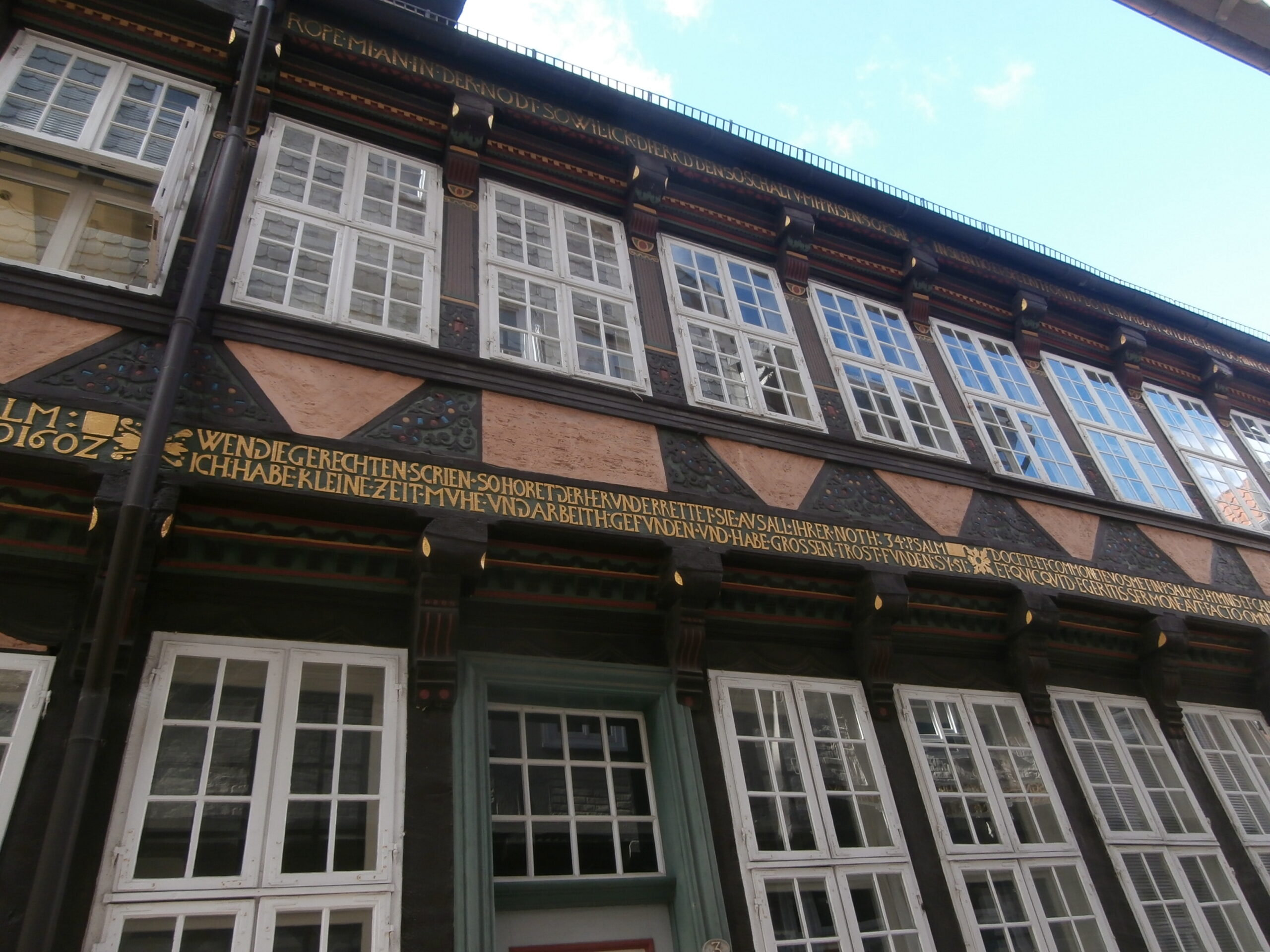
house in Celle

A text used in the German Requiem, on the Latin School in Celle, near Hannover.


Hannover is a familiar city to me as I’ve visited it several times for other reasons, though not for quite a few years. We had free time to explore as well as an organised guided tour, while our evenings were for rehearsals and the performances in the Marktkirche (where I once heard the church’s choir sing a rather shaky performance of Lobet den Herrn at a service).

We all coped with the bilingual rehearsals and were glad that we got two shots at showing what we could do. Though the German Requiem is a strenuous work to sing even once, and I found my voice fraying by the end of the second performance! An additional bonus for me was that I hadn’t performed with an orchestra of any size for several years, as a result of the pandemic and the closure of Colston Hall/Bristol Beacon, and now I finally got the chance to do so.

Our concerts also included an orchestration of Brahms’ Vier ernste Gesänge by Detlev Glanert, sung by our baritone soloist. These were expanded with a ‘prelude’ to each one in a more modernist style (I detected the influence of the Three Orchestral Pieces, amongst other things).

It was good to travel to perform at someone else’s invitation rather just to indulge ourselves, and we felt very appreciated. (Germany makes rather more out of twinning arrangements than we do, for example by displaying coats of arms of twinned cities prominently.) It’s likely that we will see our Hanoverian acquaintances again for a return leg in the future. [This happened in summer 2024.]

Posted in singing in concerts | Tagged , , , , , , , | Leave a comment

seasonal music

Forced by a rail strike to stay a night in London in order to catch my Eurostar, I made use of the opportunity to go to the Barbican and hear a choral work I’ve never sung, Haydn’s The Seasons, performed by the Academy of Ancient Music conducted by Laurence Cummings.

It has some of the relentless positivity (with occasional darker interludes) of The Creation. As I was on my way to Germany, I’d hoped to get some exposure to the language at this concert, so was a little disappointed to find the performance was in English. Not one of the standard ones in vocal scores, but one by Paul McCreesh. Sometimes ‘Ye mincing dandies stay away!’ I felt it would have been better all round left in German. Then there is the quaintly depicted relationship between the couple Lucas and Hannah, the politically incorrect celebration of hunting, and the way the piece can’t quite make up its mind whether it’s sacred or secular. On a more affirmative note, we do have a drinking song in which women are allowed to join in!

The performance was semi-staged, with the soloists Rachel Nicholls, Benjamin Hulett, and a (rather more wooden) Jonathan Lemalu suitably attired and engaging with one another. A backdrop of appropriate drawings of landscapes and weather was projected behind the choir. I had no complaints about the quality of the music-making; this performance was as likely as any to sell me the work.

However, I’m still not that sorry that I haven’t performed The Seasons, though I expect it would be fun to sing. It’s quite a long piece so I certainly got my money’s worth, and it deserved a larger audience.

Reviews:

Classical Explorer
Evening Standard

Posted in going to concerts | Tagged , , , , , , , | Leave a comment

come and sing Vivaldi

I’m a bit wary of Come and Sing events these days. They are popular with people who’ve largely retired from performing in choirs, and at the last two I’ve been to, my high notes have caused problems with nearby hearing aids. However Vivaldi’s Gloria doesn’t go high very often, so it’s reasonably safe. Bristol Choral Society will include it in our Christmas programme, but it is a work I am surprisingly unfamiliar with so I went to increase my knowledge of it. I think it is possibly the most straightforward of all standard choral works, but in spite of this (or perhaps because of it) it doesn’t stick in my memory very well.

Participants have been slow to return to Come and Sings, so it was good to almost sell out this one.

Posted in singing - other | Tagged , , | Leave a comment

the cherubim with ꙮ

The Bishop of Taunton came along to church to dedicate our new chapel to St Michael at the appropriate season. We laid on a service with three anthems, including Bairstow’s Let all mortal flesh, which I recorded many years ago with my College chapel choir, and which was one of the more notable recordings we put together in lockdown.

(The symbol at the end of the title of this post – if it renders correctly – is an Old Church Slavonic multiocular o, used in one manuscript to include the many eyes of the seraphim in a single letter. The Unicode standard for this glyph has recently changed so it has ten eyes, not seven; this is exciting news for a script geek like me.)

Posted in singing at services | Tagged , | Leave a comment

E.M.

WNO tends not to bring its (frequent) Janáček stagings to Bristol so we braved the ‘Newport bottleneck’ on the M4 to catch their production of The Makropulos Affair at the Wales Millennium Centre. Another inter-war femme fatale who goes by lots of different names.

I think this would be on my list of underrated and underperformed operas. True, if you saw it from cold you would find the plot pretty baffling, but if you start off knowing what EM’s secret is, then you can just enjoy watching the characters tie themselves in knots (it’s hardly surprising that they can’t work out what’s going on either). I don’t think there was really a need for Vitek to break the fourth wall after Act 1 and recount again what we’d just heard about. It’s quite a wordy piece, so it’s just as well that Janáček was good at setting casual, informal dialogue to music.

The production (jointly with Scottish Opera) is lavishly staged and has the usual ravishing WNO lighting.

I won’t go on about the singing and playing, as we were happy with all of it, as were the writers of the following reviews:
Guardian
The Arts Desk
Buzz
Opera Today
Bachtrack

Posted in going to operas | Tagged , , | Leave a comment

singing at the Oval

One context where I get the chance to sing (but usually don’t) is when attending sporting events. I made an exception at the (officially) third day of the Test Match between England and South Africa at the Oval.

We were sitting in the Bedser Stand, and before play the England team plus South African opening pair walked down the stairway a few yards away in silence instead of to the usual cheers, applause, trumpeter and so on. After a minute’s silence a singer, Laura Wright, appeared for what is usually a formality at internationals, the singing of the national anthems. (She obviously has a line in this, as we spotted her performing the same duty on Match of the Day a week later.) The crowd listened politely to South Africa’s polyglot anthem, but when she moved on to God Save the King – as our anthem had officially become with the proclamation of the new King an hour earlier – thousands upon thousands of us around the ground sang along. Possibly the only time the pre-match anthem was so fraught with significance at a Test might have been when South Africa returned after apartheid.

BBC commentary from Test Match Special
Cricinfo

Posted in singing - other | Leave a comment

the last night but not the Last Night

I hadn’t been to a Prom since 2019 and was determined to fit one in from this season, choosing Beethoven’s Missa Solemnis performed by the Orchestre Révolutionnaire et Romantique conducted by John Eliot Gardiner, on the Wednesday of the final week. There was of course no Last Night of the Proms in 2022, or any further concerts after this one.

I had never heard the Mass in performance before although I have sung it. This performance was well played and sung by the smallish choir, (the lower pitch making the vocal writing less strenuous) though I missed the magical sound you can achieve when many people sing really quietly. Perhaps this was why I felt that overall it didn’t have as much of a sense of awe as I’d have wished.

One thing surprised me: JEG places great emphasis on the period sound of his orchestra and his desire to get behind twentieth-century performance practice to rediscover earlier works afresh. But the Mass was sung with Italian pronunciation, not the German Latin which is now common in performances of this work (including the one I sang in a few years ago).

Usually the soloists are in front of the orchestra, holding their scores. But here the soloists (a well-matched group) were placed behind the orchestra and off-centre, in front of the men in the choir. They were equipped with music stands. which made possible something that transformed the performance for me: with her hands free, the soprano Lucy Crowe was able to move them expressively. A reminder that you have to bring your whole body to this work, otherwise it is unsingable.

Unfortunately my view of all this was spoilt by someone between me and the performers who kept shuffling some A4 sheets of paper on his knee throughout. If they had a compulsion to fidget, perhaps they should have been given something smaller and darker, which would have been less distracting, or been taken to the Relaxed Prom earlier in the day? If they didn’t, there really isn’t much excuse.

Another unsatisfactory matter was the printed programme. I have found these useful in the past, particularly when new music is being performed. But there were scanty column inches on the Mass, which told me little I didn’t already know. Comparing it to the programme for my performance of Mahler 8 in 2018, which devoted about twice as much space to the work being performed. I felt rather short-changed and will think twice before buying a programme at the Proms in future.

Some reviews:

The Classical Source
The Arts Desk
Guardian
Lobe News

Posted in going to concerts | Tagged , , , , , | Leave a comment

A busy morning at the Abbey

Although I have sung a number of morning services at Bath Abbey with its Chamber Choir, I don’t think I’ve sung two back to back. It makes for a long morning! We met at 8.30 to rehearse, and sang an anthem (Lennox Berkeley’s setting of Psalm 23) at the first service at 9.30. Then a quick turnaround before the second service at 11.30 where the setting was Darke in F and we also performed an introit (Bairstow’s Jesu the very thought) and an anthem new to me (Byrd’s Ego sum panis vivus). A lot of the choir were still away so we were small in number; unfortunately I can’t do the next couple of engagements so it will be November before I perform with them again.

Posted in singing at services | Tagged , , , , , | Leave a comment

Requiem preparation and a funeral

My second overseas choir tour of the year approaches and in preparation for it the director of the German choir we’ll be joining forces with came over to take a day-long rehearsal. We’ll be singing Brahms’ German Requiem (twice!), which Bristol Choral Society sang back in 2017; I wasn’t able to sing in that concert though I went to rehearsals and have sung it since with the four-hand accompaniment. It was a useful chance to learn his interpretation and priorities and show him that we knew the piece well.

Sadly there was a real funeral a few days later, of a former chair of trustees at church. We sang Mozart’s Ave Verum, a familiar piece but one that isn’t normally in the choir’s repertoire although a number of the congregation would like it to be.

Posted in singing at services | Tagged , , , | Leave a comment

a brief burst of Philips

I only gave one performance in August – a Eucharist (including a baptism) at Bath Abbey with the Abbey Chamber Choir.  Our anthem was a piece new to me Peter Philips’ Ave verum.   We were sparse because of people being on holiday, so our conductor accompanied us on the chamber organ to fill in a missing part, and unlike the choir’s previous performance of it the motet wasn’t transposed down.  (It is easier to keep the rather high soprano line on pitch if you are accompanied.)   Normally I’d be doing a Cathedral visit in August, usually with the Cathedral Chamber Choir, but not this year – other activities including two foreign choir tours have limited the time I can give up.

Also went to a service at my church led by some of those on the RSCM course held this summer at Kingswood School; these courses have been an addition to summer church music in Bath for many years.

Posted in singing in concerts | Tagged , , , , | Leave a comment